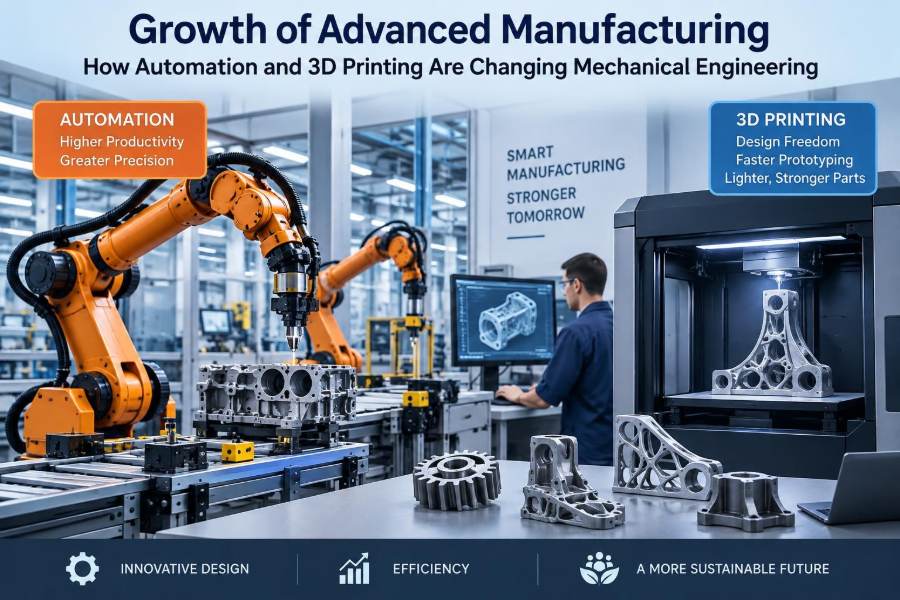

A production line stops because a replacement part is unavailable. A design team needs a working prototype before the week is over. A technician notices a robot placing components with the same motion, thousands of times, while another operator adjusts a machine using data from a digital dashboard.
These are no longer separate stories. They are everyday examples of advanced manufacturing: the growing use of automation, digital tools, and additive manufacturing to design and make physical products more effectively.
For mechanical engineers, the shift changes more than factory equipment. It affects how parts are designed, how quality is checked, how materials are selected, and which skills are most valuable on the job.
Understanding these tools does not mean assuming every product should be robotic or 3D printed. It means knowing what each method can do, where it falls short, and how to combine it with sound engineering judgment.
🏭 What Advanced Manufacturing Means
Advanced manufacturing is a broad term for production methods that use digital control, connected data, automation, advanced materials, and flexible processes. It includes familiar technologies such as CNC machining alongside newer approaches such as collaborative robots, machine vision, industrial sensors, and metal additive manufacturing.
The defining feature is not simply that a machine is sophisticated. It is that information can move more directly between design, production, inspection, and improvement.
🔄 Why Manufacturing Is Becoming More Connected
Traditional production often passes information through separate steps: design creates drawings, manufacturing plans processes, operators run equipment, and inspectors review finished parts. Each handoff can introduce delays or interpretation errors.
Connected manufacturing uses digital models, production data, and shared systems to shorten those gaps. A design revision can be reviewed against tooling limits sooner, while measured dimensions can reveal whether a process is drifting before many nonconforming parts are made.
🧩 The Mechanical Engineer’s Expanding Role
Mechanical engineers still apply mechanics, materials science, thermodynamics, and machine design. Advanced manufacturing adds a systems perspective: a part must work mechanically, but it must also be measurable, producible, serviceable, and economically sensible.
An engineer may now collaborate closely with programmers, controls specialists, data analysts, quality engineers, and operators. Clear communication matters because a technically elegant design can fail in production if its requirements are unclear or impractical.
🤖 Automation Is More Than Robots
Industrial robots are highly visible, but automation includes any system that performs a task with limited direct human intervention. A CNC machine changing tools automatically, a conveyor routing parts, and software scheduling work orders are all forms of automation.
The goal is usually consistency, throughput, safety, or traceability—not removing people from every decision. Effective systems assign repetitive, hazardous, or precisely repeatable tasks to machines while retaining human oversight where judgment is needed.
🦾 Industrial Robots and Their Best Uses
Traditional industrial robots are especially useful for repetitive tasks with stable conditions. Common applications include welding, painting, palletizing, machine tending, sealing, and material handling.
They are strongest when the part location, cycle sequence, and required motion are well defined. If incoming components vary widely, fixtures are poor, or the task changes every few hours, a robot may require additional sensing and programming before it becomes worthwhile.
🤝 Collaborative Robots Change the Deployment Model
Collaborative robots, often called cobots, are designed to operate with safety features that can support closer work near people when a proper risk assessment allows it. They are often compact and easier to redeploy than large fenced robot cells.
That does not mean cobots are automatically safe in every situation. Tooling, payload, speed, pinch points, and unexpected movement all matter. Safety must be engineered for the complete application, not assumed from the robot label.
👁️ Machine Vision Gives Equipment Feedback
Machine vision combines cameras, lighting, optics, and software to inspect or guide a process. A vision system might confirm a label is present, locate a component before robotic pickup, check an assembly orientation, or detect an obvious surface defect.
Reliable vision depends heavily on controlled lighting and clear acceptance criteria. A camera is not a universal substitute for inspection; reflective surfaces, shadows, part variation, and ambiguous defects can make results unreliable.
📡 Sensors Turn Processes Into Data
Temperature, force, vibration, pressure, position, electrical current, and humidity sensors can reveal what a process is doing while it runs. For example, rising spindle vibration may suggest a tool, fixture, or bearing issue worth investigating.
Data only becomes useful when it is connected to a question. Collecting every possible signal without a plan can create noise, storage burdens, and false alarms rather than useful improvement.
🧠 Digital Twins Support Better Decisions
A digital twin is a digital representation of a physical product, process, or system that is updated using relevant design and operating information. It can range from a simple model used for simulation to a more connected representation informed by sensor data.
For mechanical engineering, a twin can help examine loads, cycle times, energy use, or process changes before modifying the physical system. Its value depends on valid assumptions; an impressive model with inaccurate inputs can mislead confidently.
💻 CAD, CAM, and the Digital Thread
Computer-aided design (CAD) defines geometry and engineering intent. Computer-aided manufacturing (CAM) converts geometry into machining strategies and toolpaths. The digital thread describes the connected flow of information across the product lifecycle.
When these systems are well managed, the same controlled model can inform design reviews, CNC programming, inspection planning, and service documentation. Version control is essential: manufacturing the correct part very accurately is still a failure if it uses an obsolete revision.
🖨️ What 3D Printing Actually Is
3D printing, also called additive manufacturing, creates a part by adding material layer by layer from a digital model. This differs from machining, which removes material from stock, and molding, which shapes material inside a dedicated tool.
The phrase covers several process families rather than one machine type. Material behavior, surface finish, build speed, dimensional capability, and post-processing requirements vary substantially between them.
🧵 Polymer Printing for Prototypes and Tools
Polymer additive processes are widely used for concept models, fit checks, fixtures, jigs, enclosures, and low-volume parts. Some processes deposit softened thermoplastic filament, while others cure liquid resin or fuse polymer powder.
A printed fixture can be useful when a production team needs a custom locator quickly. However, engineers should still examine stiffness, heat resistance, wear, chemical exposure, and creep—the gradual deformation of some plastics under sustained load.
🔥 Metal Additive Manufacturing for Complex Parts
Metal additive manufacturing can build complex metal geometry that would be difficult or impossible to machine as a single piece. Internal channels, lattice structures, and consolidated assemblies are common reasons to consider it.
But printing metal is not simply pressing “make.” Powder handling, thermal distortion, residual stress, support structures, heat treatment, machining, and inspection may all be part of the manufacturing route. The finished part must meet its intended performance requirements, not merely resemble the CAD model.
🧪 Material Choice Still Governs Performance
A process does not make a material suitable by itself. A polymer chosen for a visual prototype may be inappropriate near heat or fuel. A metal alloy selected for corrosion resistance may require a different process route than one selected for high strength.
Mechanical engineers must consider anisotropy, meaning properties that differ by direction. Layered manufacturing can produce direction-dependent behavior, so build orientation and post-processing are engineering decisions rather than cosmetic settings.
📐 Design for Additive Manufacturing
Design for additive manufacturing, often shortened to DfAM, means designing around the opportunities and constraints of layer-based production. It may reduce assembly count, place material only where loads require it, or create internal flow paths that improve thermal performance.
Good DfAM is not just making a familiar bracket look organic. The engineer begins with loads, interfaces, allowable movement, safety factors, inspection access, and production needs, then uses geometric freedom purposefully.
🪚 Design for Automation Starts With Simplicity
Automated handling works best when a part can be presented, located, and gripped consistently. Small design changes—adding a flat datum, avoiding tangling features, creating a clear gripping zone, or standardizing fasteners—can simplify an entire cell.
Consider a hypothetical washer-like part with two nearly identical sides. A human may recognize the correct orientation instantly, while a robot may need extra vision, fixturing, or a costly error-proofing feature. Designing in an obvious asymmetry can prevent that problem.
⚖️ Additive and Conventional Manufacturing Are Complements
3D printing does not replace machining, casting, forging, sheet forming, or injection molding across the board. Conventional processes often remain better for high-volume production, excellent surface finish, tight tolerances, or established material properties.
| Method | Often a strong fit for | Typical engineering consideration |
|---|---|---|
| Additive manufacturing | Complex geometry, rapid iteration, low-volume customization | Post-processing, orientation, build time, qualification |
| CNC machining | Precision features, broad material choice, finishing operations | Material waste and tool access |
| Molding or casting | Repeated production after tooling is justified | Tooling lead time and design changes |
| Forming and fabrication | Sheet structures, frames, and common industrial assemblies | Joining, springback, and fixture design |
Many capable production routes are hybrid: print a near-net-shape feature, machine critical interfaces, and inspect the completed part.
🎯 Tolerances Do Not Disappear
A digital model may contain exact dimensions, but real parts always vary. Tolerancing defines the acceptable range of variation needed for fit and function. Advanced equipment can improve control, yet it does not eliminate thermal effects, tool wear, material shrinkage, or measurement uncertainty.
Engineers should specify tolerances based on functional need. Applying extremely tight limits everywhere can raise cost, slow production, and create unnecessary scrap without improving the product.
🔍 Inspection Must Match the Process
Quality assurance in advanced manufacturing may include coordinate measuring machines, laser scanning, in-process sensing, vision inspection, and destructive testing of representative samples. The appropriate method depends on the feature, material, consequence of failure, and required confidence.
For critical applications, process qualification and traceability can be as significant as final dimensional inspection. A part can measure correctly while still containing internal conditions or material variability that require separate evaluation.
🛠️ Predictive Maintenance Has Practical Limits
Predictive maintenance uses condition data to estimate when equipment may need attention. Instead of replacing components only on a fixed calendar or waiting for breakdown, a team may monitor trends such as vibration, temperature, or motor current.
This approach can help prioritize maintenance, but a sensor trend is not a diagnosis by itself. Changes may arise from operating conditions, sensor placement, or normal production variation. Experienced maintenance and engineering review remain necessary.
🧍 Human Skills Remain Central
Automation changes tasks; it does not remove the need for people who can understand processes. Operators often notice abnormal sounds, inconsistent material behavior, awkward loading, or emerging defects before dashboards make the issue obvious.
Organizations gain more from automation when they involve the people who run and maintain equipment. Their practical knowledge helps identify realistic failure modes, safer workflows, and improvements that work beyond a demonstration cell.
📚 Skills Mechanical Engineers Should Build
Mechanical engineers do not need to become experts in every software platform or robot language. They do benefit from being conversant across disciplines and able to ask precise questions.
- Fundamentals of CAD, CAM, tolerancing, and manufacturing process selection
- Basic robotics concepts: coordinate frames, end effectors, fixtures, and safe operating zones
- Data literacy: sensor limits, trends, uncertainty, and sensible visualization
- Materials and post-processing knowledge for polymer and metal additive methods
- Experimental planning, root-cause analysis, and technical documentation
Small projects—such as designing a fixture, programming a simple motion, or comparing printed orientations—often build understanding faster than passive familiarity.
💼 Changing Career Paths in Manufacturing
Advanced manufacturing creates roles at the boundaries between disciplines: manufacturing automation engineer, additive applications engineer, process development engineer, production quality engineer, and digital manufacturing specialist.
Job titles vary by organization, but the underlying value is consistent. Employers need people who can translate a product requirement into a stable process, understand trade-offs, and communicate with teams using different technical languages.
💰 Cost Requires a Whole-System View
A robot or 3D printer should not be judged only by purchase price. Useful cost analysis includes fixtures, safety systems, programming, training, maintenance, consumables, validation, floor space, production rate, and the cost of process interruptions.
Likewise, an additive part may reduce assembly labor or inventory even if its unit manufacturing cost is higher than a simple machined part. The right comparison asks what the complete product and supply chain require.
⚠️ Common Implementation Mistakes
A frequent mistake is automating an unstable process. If parts arrive inconsistently, instructions are unclear, or the root cause of defects is unknown, automation may make the confusion happen faster.
- Choosing technology before defining the production problem
- Ignoring fixturing, material presentation, and maintenance access
- Using prototype material data for a safety-critical final part
- Underestimating validation and inspection needs
- Treating training as optional after installation
Start with a measurable problem and a realistic operating environment rather than a desire to use a fashionable tool.
🛡️ Safety, Cybersecurity, and Responsible Use
Connected equipment introduces both physical and digital risks. Guarding, emergency stops, lockout procedures, safe robot motion, powder controls, ventilation, and personal protective equipment must fit the process being used.
Networked systems also need sensible access control, backup practices, and change management. A production setting should treat software updates, machine settings, and digital design files as controlled elements because unintended changes can affect real hardware.
🌱 Sustainability Depends on the Application
Advanced manufacturing can reduce material removal, support localized spare-part production, consolidate assemblies, or improve energy use through better process control. These benefits are possible, not automatic.
Energy demand, scrap powder or polymer handling, failed builds, post-processing, transportation, and product lifetime all influence environmental impact. Engineers should evaluate the full lifecycle rather than assume a newer process is inherently greener.
🧭 A Practical Adoption Roadmap
Teams usually make better decisions by introducing technology in stages. Begin with a bounded problem: a recurring ergonomic lift, a slow inspection step, an obsolete low-volume spare part, or a fixture that delays changeovers.
- Define the current process, constraints, and success measure.
- Check whether a simpler process improvement solves the issue first.
- Prototype the technical solution and involve operators early.
- Validate quality, safety, uptime, and maintenance requirements.
- Standardize the successful process before expanding it.
This approach prevents a promising demonstration from becoming an unreliable production burden.
🔮 Where the Field Is Heading
Manufacturing will likely become more adaptive as sensing, simulation, automation, and material processing improve. The most useful advances may be less dramatic than fully autonomous factories: faster feedback, better setups, stronger traceability, and more flexible production of specialized parts.
Progress will remain constrained by physics, economics, regulation, workforce capability, and the need to prove reliability. Those constraints are not obstacles to ignore; they are design inputs.
🔑 The Core Principle for Mechanical Engineers
The central lesson is not “automate everything” or “print everything.” It is to select a process that delivers the required function, quality, safety, rate, and cost for the real application.
Automation and additive manufacturing are powerful because they expand the engineer’s options. They work best when grounded in sound design, material knowledge, careful validation, and respect for the people who operate the system.
Advanced manufacturing succeeds when digital capability is paired with practical mechanical engineering judgment. Engineers who understand both the technology and its limits will be better prepared to improve the products and production systems around them. ⚙️🤖🖨️