
A mechanical engineer may begin the day reviewing a pump drawing, troubleshooting a production-line stoppage, or checking whether a new battery enclosure can survive vibration and heat. By lunch, a colleague in another mechanical role may be modeling aircraft components or planning the maintenance strategy for an entire plant.
Both may share the same degree title, yet their pay can develop very differently. The reason is not simply that one job is “better” than another. Salary reflects the value of the problem being solved, the scarcity of the required skills, the industry’s economics, location, responsibility, and the engineer’s ability to turn technical work into reliable results.
That makes specialization a career decision, not just a course-selection decision. It can shape the tools you learn, the projects you can access, the risks you manage, and eventually the range of roles for which employers will compete.
Higher earnings are possible in several mechanical engineering paths, but no specialization is a guaranteed shortcut. A useful choice matches market demand with work you can become genuinely capable at doing.
🧭 What “Higher Earnings” Actually Means
Salary discussions often focus on base pay, but an engineer’s total compensation can include overtime, shift differentials, bonuses, retirement contributions, equity, relocation support, travel allowances, and performance incentives. A field role at a remote site may pay differently from an office-based design role even when the job titles sound similar.
It also helps to separate early-career pay from long-term earning potential. A specialization may offer a strong entry salary but limited advancement, while another starts more modestly and creates routes into technical leadership, project management, consulting, or business ownership.
📈 Why Specialization Influences Pay
Employers pay more when a role affects costly outcomes: uptime, safety, production capacity, regulatory compliance, product performance, or capital-project risk. A specialist who prevents a recurring turbine failure, shortens a product-development cycle, or improves manufacturing yield can influence far more value than their individual salary.
Specialization also reduces the time needed to become productive. Someone who already understands fatigue analysis, pressure-system design, or industrial controls needs less supervision than a generalist entering an unfamiliar high-consequence environment.
⚖️ The Supply-and-Demand Equation
Pay tends to rise where companies need particular capabilities faster than qualified people become available. This can happen when technology changes quickly, a sector is expanding, or a role demands a difficult mix of mechanical knowledge, software skill, regulations, and practical experience.
Demand is not permanent. A popular sector can slow, and a niche skill can become less valuable if tools or manufacturing methods change. Rather than chasing a job title alone, watch whether the underlying problem—energy reliability, automation, thermal control, safety, or efficient production—is likely to remain relevant.
🏭 Industry Often Matters More Than the Degree Title
A mechanical engineer working in consumer products, heavy equipment, energy, medical devices, aerospace, and process manufacturing may use similar fundamentals. Yet their employers face different margins, project budgets, regulations, and consequences of failure.
For example, a design revision for a low-cost consumer item may be evaluated mainly on manufacturability and unit cost. A revision to equipment used in a tightly regulated or safety-critical setting may require extensive verification and documentation. That additional responsibility can support higher compensation, though it also creates more accountability.
📍 Location Changes the Salary Calculation
Engineering hubs, industrial corridors, and regions with large energy, aerospace, automotive, or advanced-manufacturing operations often create more competition for experienced engineers. Pay may be higher, but housing, taxes, commuting, and travel demands can consume much of the difference.
A better question than “Where is the biggest salary?” is “Where can I build valuable experience while maintaining a workable quality of life?” Cost-adjusted income, career mobility, and proximity to mentors can matter more than the headline offer.
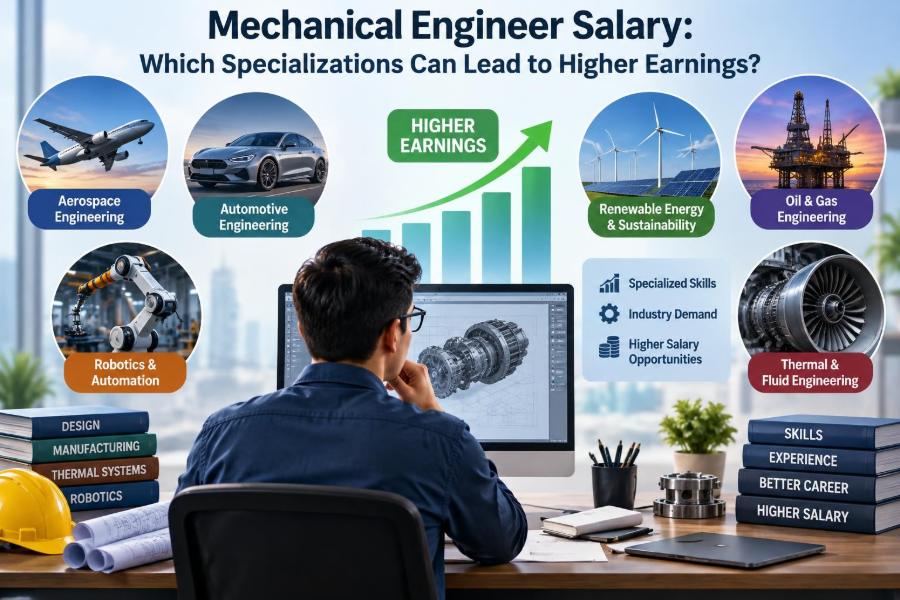
🛩️ Aerospace and Defense Engineering
Aerospace mechanical engineers work on structures, propulsion-related hardware, thermal systems, mechanisms, test equipment, and manufacturing processes. The work commonly demands disciplined design reviews, traceability, configuration control, and rigorous validation because failures can be extremely costly.
These requirements can create well-paid specialist opportunities, especially for engineers with experience in lightweight structures, vibration, thermal management, materials, or test. Access restrictions, long development cycles, and location constraints are real trade-offs. Not every role involves aircraft design; suppliers, test facilities, and manufacturing teams also need mechanical talent.
🔋 Energy Systems and Power Generation
Energy work includes conventional power plants, renewable generation, energy storage, grid-support equipment, and large industrial utilities. Mechanical engineers may focus on turbines, heat exchangers, rotating equipment, piping, cooling systems, or reliability programs.
Higher compensation is often associated with roles carrying operational responsibility, site travel, outage work, or deep expertise in expensive assets. The work can involve urgent decisions, strict safety procedures, and irregular schedules. Engineers attracted to this path should value reliability and field problem-solving, not only the salary premium.
🛢️ Oil, Gas, and Process Industries
Process industries use equipment that moves, heats, compresses, separates, or stores fluids at large scale. Mechanical roles can include piping, pressure vessels, pumps, compressors, static equipment, inspection, maintenance, and project engineering.
These industries may offer strong earnings where operations are remote, assets are capital-intensive, or downtime is expensive. Cyclical commodity markets, travel, and site conditions can make employment less predictable than in some sectors. Transferable skills in rotating equipment, corrosion awareness, and process safety can broaden options beyond one industry.
🤖 Automation, Robotics, and Mechatronics
Mechatronics combines mechanical design with electronics, sensors, controls, and software. Engineers in this space build automated machinery, robot end effectors, test stations, conveyor systems, and production cells.
Pay can rise for people who can bridge disciplines: designing a fixture is useful, but designing it so sensors detect errors, actuators move safely, and controls logic coordinates the sequence is more scarce. A mechanical engineer does not need to become a full-time programmer, but basic literacy in controls and data flow is increasingly valuable.
🏗️ Advanced Manufacturing and Industrial Engineering
Manufacturing specialists improve the systems that turn designs into repeatable products. Their work may involve tooling, machining, welding, additive manufacturing, assembly processes, quality planning, automation, and plant layout.
Engineers who can connect design choices to cycle time, scrap, ergonomics, and process capability are valuable because small improvements multiplied across many units can be substantial. Earnings often grow as responsibility expands from one workstation to an entire production line or factory program.
🧪 Medical Devices and Biomechanics
Medical-device engineering applies mechanical principles to instruments, implants, diagnostic equipment, rehabilitation devices, and manufacturing systems. Product safety, usability, materials compatibility, cleaning, and verification all matter alongside performance.
Regulated product-development experience can be particularly valuable because it requires structured documentation and careful change control. The field may demand patience: a clever prototype is not enough if it cannot be manufactured consistently, tested appropriately, and supported by a defensible design history.
🌡️ Thermal Engineering and Heat Transfer
Thermal engineers manage heat where it limits performance, reliability, comfort, or safety. Applications range from HVAC equipment and buildings to engines, electronics cooling, batteries, industrial furnaces, and heat-recovery systems.
This specialization can command higher pay when thermal limits are central to product success. For instance, a compact device can fail early if heat cannot leave sensitive components, while an inefficient industrial thermal system can raise operating costs for years. Strong candidates combine calculations, simulation, test data, and practical knowledge of manufacturing constraints.
💨 HVAC, Refrigeration, and Building Systems
HVAC engineering is sometimes underestimated because heating and cooling are familiar everyday services. In reality, large commercial, health-care, laboratory, and industrial facilities require careful control of airflow, humidity, filtration, pressure, noise, energy use, and resilience.
Specialized knowledge in high-performance buildings, clean environments, refrigeration, or complex central plants can lead to stronger opportunities. The path may include design consulting, commissioning, controls, facilities engineering, or project leadership. Local codes and climate conditions influence the work considerably.
🌀 Rotating Equipment and Reliability
Pumps, fans, compressors, gearboxes, motors, turbines, and bearings are essential across industry. Failure can halt production, create safety risks, or damage connected systems, which makes reliability specialists commercially significant.
Useful expertise includes vibration analysis, lubrication, alignment, balancing, root-cause analysis, condition monitoring, and maintenance planning. This work rewards engineers who enjoy diagnosing incomplete evidence: a vibration trend, temperature increase, or unusual noise may reveal a problem before a catastrophic failure occurs.
🧱 Materials, Failure Analysis, and Joining
Materials engineers and mechanical specialists in this area investigate why parts crack, corrode, wear, deform, or fail under repeated loading. They may also develop welding, adhesive bonding, heat treatment, coating, and material-selection processes.
Higher-value roles often arise when failures are expensive or safety-critical. Understanding fracture mechanics, fatigue, corrosion mechanisms, and inspection limits can distinguish an engineer from someone who selects materials only by strength listed on a data sheet.
🧮 Simulation, FEA, and Digital Engineering
Finite element analysis, usually called FEA, estimates how a component responds to loads, temperature, vibration, or contact conditions. Computational fluid dynamics, or CFD, models fluid flow and heat transfer. These tools can reduce prototype iterations when used thoughtfully.
Tool proficiency alone does not create a high-value analyst. Good engineers choose reasonable assumptions, check mesh quality and boundary conditions, compare results with hand calculations or test data, and explain uncertainty. A colorful stress plot without validation can be misleading and costly.
🚗 Automotive, Mobility, and Electrification
Mobility engineering includes conventional vehicles, electric vehicles, rail, off-highway equipment, and charging or battery-supporting hardware. Mechanical opportunities include structures, crash-related components, thermal systems, manufacturing, noise and vibration, and test.
Electrification creates demand for engineers who understand battery-pack structures, cooling plates, sealing, vibration durability, and production methods. Sector conditions can shift quickly with consumer demand and investment cycles, so broad capabilities in thermal systems, manufacturability, and validation provide useful resilience.
🧩 Product Design and Design for Manufacture
Product design engineers translate a need into parts, assemblies, prototypes, drawings, and production-ready specifications. The highest-paid design roles generally go beyond CAD modeling: they balance performance, tolerances, materials, cost, assembly, serviceability, and supply-chain reality.
Design for manufacture means making a product easy and economical to produce consistently. An elegant assembly that needs difficult machining, excessive inspection, or delicate manual alignment may be less valuable than a slightly simpler design that works reliably at scale.
📋 Systems Engineering and Technical Integration
Complex products rarely fail because one component was designed in isolation. Systems-oriented mechanical engineers manage interfaces among structures, electronics, software, thermal limits, users, manufacturing, and test requirements.
These roles can lead to higher earnings as project complexity increases because integration failures are expensive and difficult to resolve late. The work requires communication as much as calculation: engineers must clarify requirements, document decisions, and identify trade-offs before teams commit to hardware.
🧑💼 Project Engineering and Capital Projects
Project engineers coordinate technical scope, schedules, vendors, installation, commissioning, budgets, and risk on projects such as plant expansions, utility upgrades, industrial equipment installations, or new production lines.
Compensation can grow with the scale of assets and the engineer’s authority. However, project work is not merely a management title. A project engineer must still recognize when a supplier’s proposal, construction sequence, or design change introduces a technical or operational problem.
🦺 Safety, Codes, and Regulated Responsibility
Some mechanical roles involve equipment that can injure people or cause major damage if designed, installed, or maintained poorly. Pressure systems, lifting equipment, machinery guarding, fire-related systems, and industrial plants all operate within layers of codes, standards, and employer procedures.
Experience applying those requirements can improve earning potential because it lowers organizational risk. It should never be treated as paperwork alone. Engineers need to understand the physical hazard behind the requirement and know when a qualified specialist or responsible authority must review the work.
🎓 Licensure, Certifications, and Credentials
Professional licensure can matter greatly in roles where engineers take responsible charge of public-facing design work, sign or seal documents where permitted, or advance within consulting organizations. Requirements vary by jurisdiction, so candidates should verify the rules that apply where they plan to work.
Certifications can help when they reflect real capability in project management, quality, reliability, safety, inspection, or a specific technology. A credential is most useful when supported by projects that demonstrate judgment; collecting certificates without practical evidence rarely changes a career by itself.
🛠️ Build a Skill Stack, Not a Narrow Label
The strongest salary position often comes from combining a core specialization with adjacent skills. A thermal engineer who understands FEA and test instrumentation, or a manufacturing engineer who can automate data collection and lead supplier discussions, can solve a wider class of problems.
- Build deep competence in one technical area.
- Learn the software, data, and documentation used around it.
- Understand cost, safety, quality, and production implications.
- Practice explaining technical decisions to non-specialists.
This approach avoids becoming a generalist with no clear strength while protecting against dependence on one narrow tool or sector.
🗂️ Choose Projects That Signal Value
Employers assess evidence, not just interest. A student project, internship task, or early-career assignment becomes more persuasive when it states the problem, constraints, method, result, and lesson learned.
For example, “modeled a bracket in CAD” says little. “Redesigned a bracket under a defined load case, checked stiffness and fastening assumptions, and simplified it for fabrication” shows engineering thinking. Confidential work can still be described without revealing proprietary dimensions, customers, or performance data.
🗣️ Communication Can Raise Technical Value
An engineer may identify the correct solution but lose influence if the analysis is confusing, late, or disconnected from decisions. Clear reports, drawings, review presentations, and concise risk explanations make technical work easier to act on.
Communication does not mean simplifying away the engineering. It means stating assumptions, uncertainty, consequences, and recommended next steps so a manager, technician, supplier, or customer can respond appropriately.
🔄 Switching Specializations Without Starting Over
Career changes are common because mechanical fundamentals transfer. Statics, dynamics, thermodynamics, materials, manufacturing, and design reasoning remain useful across sectors, even when terminology changes.
A practical transition starts by identifying overlap. A maintenance engineer moving into reliability can emphasize root-cause analysis and rotating equipment; an HVAC engineer moving into thermal product design can strengthen simulation and prototype testing. Bridge projects, targeted courses, and internal transfers often reduce the risk of a complete restart.
🚫 Common Salary-Chasing Mistakes
The first mistake is pursuing a high-paying niche without considering whether its daily work suits you. Travel, plant environments, repetitive compliance tasks, emergency callouts, or long program cycles can become exhausting when chosen only for compensation.
Other avoidable errors include:
- Assuming a software package is a specialization rather than a tool.
- Ignoring geography and total cost of living.
- Changing jobs repeatedly without building demonstrable depth.
- Overlooking safety, documentation, and teamwork because they seem less technical.
- Comparing offers without considering hours, benefits, travel, and advancement paths.
🤝 Negotiating From Evidence, Not Hype
Negotiation is stronger when it connects your experience to the employer’s needs. Prepare examples of technical problems solved, tools mastered, systems improved, projects delivered, or risks reduced. Be accurate about your role and ready to discuss what you want to learn next.
If salary flexibility is limited, ask about the whole package: review timing, training support, overtime policy, relocation, project scope, mentoring, flexible arrangements, and advancement criteria. A role with meaningful responsibility and guidance can be worth more over several years than a slightly larger initial number.
🌱 A Practical Plan for Students and Early-Career Engineers
Start broad enough to discover what kind of problems hold your attention, then narrow through real work. Coursework provides the language; labs, internships, shop experience, design teams, and field exposure reveal whether you enjoy the pace and constraints of a specialization.
- Choose one area to explore deeply for the next year.
- Complete a portfolio-worthy project with measurable constraints.
- Learn one industry-relevant tool and its limitations.
- Speak with practitioners about the ordinary work, not only highlights.
- Review your direction after gaining actual project experience.
Deliberate exploration is more useful than waiting for a perfect lifelong choice.
🎯 The Core Principle: Valuable Problems Create Valuable Careers
The specializations most likely to support higher earnings are usually connected to expensive, difficult, regulated, or rapidly changing problems: keeping critical equipment running, managing heat, automating production, developing complex products, assuring safety, and integrating systems.
Yet specialization works best when it is built on solid mechanical fundamentals and proven judgment. The goal is not to find one universally highest-paid title. It is to become the engineer who can reliably solve a problem an organization cannot afford to ignore.
Higher mechanical engineering earnings usually follow sustained capability, relevant responsibility, and a specialization that solves meaningful real-world constraints—not a job label alone. Choose a direction, build evidence through projects, and keep expanding the skills that make your work useful. ⚙️📈🛠️