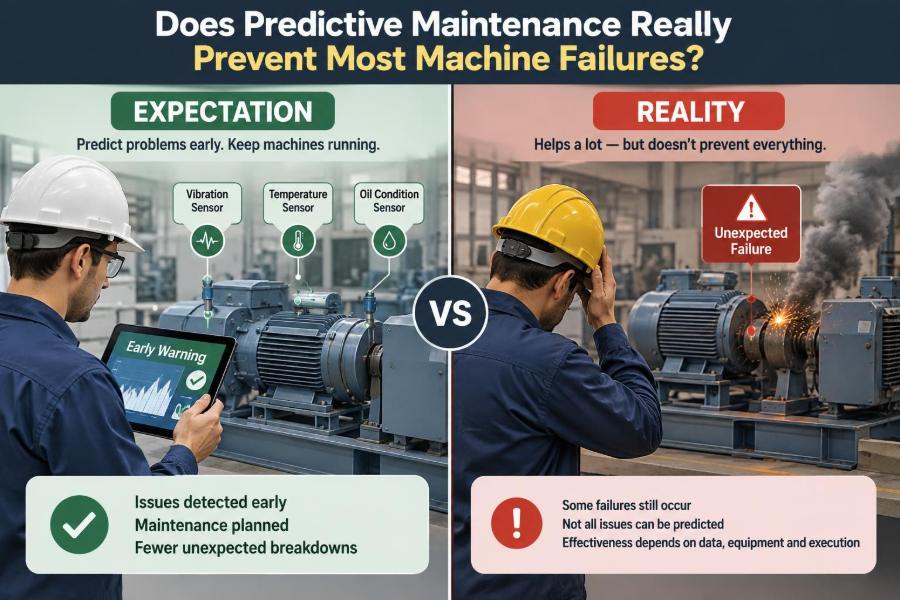

The production line is running normally when a bearing alarm appears on the dashboard. The maintenance team has a choice: stop a valuable asset now, inspect it, and possibly find nothing urgent—or keep running and hope the warning is not the start of a costly failure.
This is the promise that makes predictive maintenance so attractive. Instead of replacing parts on a calendar or waiting for a breakdown, organizations aim to intervene only when a machine’s condition says action is needed.
But a dashboard full of trends does not automatically prevent failures. Sensors can miss the relevant fault, data can be misunderstood, and some components fail with little or no measurable warning.
Predictive maintenance can be exceptionally useful, but its real value comes from matching the method to the failure mode, the machine, and the decisions people can actually make.
🔍 The simple expectation behind predictive maintenance
The expectation is straightforward: monitor a machine continuously, detect deterioration early, schedule a repair, and avoid an unplanned outage. In the best cases, this sequence works very well.
A degrading rolling-element bearing, for example, may develop vibration signatures before it seizes or damages its housing. Detecting that change can give a team time to order parts and plan a controlled shutdown.
The mistaken extension is assuming that all failures announce themselves early enough to predict. Machinery does not behave that uniformly.
🧭 What predictive maintenance actually means
Predictive maintenance, often called PdM, uses condition data to estimate whether an asset is degrading and when intervention may be justified. The goal is not merely to collect measurements; it is to make better maintenance decisions.
It sits within condition-based maintenance, where maintenance is triggered by evidence of condition rather than by elapsed time alone. Prediction may be a detailed remaining-useful-life estimate, but in many plants it is more modest: identifying abnormal behavior early enough to investigate.
🛠️ Preventing failure is not the same as predicting it
A useful distinction is often lost in conversation. Predictive maintenance may detect a developing fault, while the actual prevention comes from the repair, operating change, lubrication correction, alignment work, or replacement that follows.
If an analyst identifies increasing vibration but no work order is approved before damage spreads, the monitoring system did not prevent the failure. It provided information; the maintenance process failed to convert it into action.
📉 Why “most failures” is an unreliable promise
Whether PdM prevents most failures depends on what “most” includes. A facility may have many minor failures caused by contamination, operator error, electrical disturbances, software issues, loose connections, process upsets, or sudden overloads.
Some failure mechanisms progress gradually and are observable. Others are random, intermittent, hidden, or so rapid that routine monitoring provides little useful warning. A claim about prevention must therefore specify the asset population and failure modes involved.
🧩 Failure mode comes before sensor selection
A failure mode is the specific way an item fails: bearing fatigue, impeller erosion, insulation breakdown, gear tooth damage, seal leakage, or lubricant degradation. Two failures on the same pump may require completely different detection methods.
Starting with a preferred technology—such as “we need wireless vibration sensors”—often produces weak programs. Start instead with: What physically changes before this failure, and can that change be measured?
🧠 The P–F interval explains the opportunity
The P–F interval is the time between the point at which a potential failure becomes detectable and the point of functional failure, when the asset can no longer perform its required duty. It is a practical reliability concept, not a guaranteed countdown clock.
A long P–F interval gives a team room to detect, diagnose, plan, and repair. A short interval demands frequent monitoring or protective systems that act faster than a human maintenance workflow can.
If a fault becomes detectable only hours before a critical failure, monthly data collection is unlikely to help. Inspection frequency must fit the available warning period.
📡 What sensors can see—and what they cannot
Sensors do not observe “machine health” directly. They measure proxies: acceleration, temperature, ultrasound, current, pressure, flow, particle counts, or process variables. The relationship between a proxy and a fault must be understood.
A temperature rise may reflect bearing friction, but it can also result from ambient heat, a changed process load, restricted cooling, or a sensor mounted in an unrepresentative location. Good measurement is the beginning of diagnosis, not the diagnosis itself.
📳 Vibration analysis and rotating equipment
Vibration analysis is especially valuable for many rotating assets. It can help identify imbalance, misalignment, looseness, resonance, certain bearing defects, and gear-related problems when measurement points, operating conditions, and analysis methods are appropriate.
Yet vibration is not universal. A slowly rotating bearing may generate a weak signal, and a complex structure may attenuate or distort vibration before it reaches the sensor. Installation quality and signal interpretation matter as much as the device.
🌡️ Temperature monitoring has a narrower message
Temperature is inexpensive, intuitive, and useful for detecting overheating in bearings, motors, electrical connections, furnaces, and lubrication systems. It often excels at identifying a condition that has already become thermally significant.
That is also its limitation. A bearing can be damaged before external temperature changes noticeably, particularly under variable load or with effective heat dissipation. Temperature trends are valuable evidence, but rarely a complete health assessment.
🛢️ Oil analysis reveals the lubricant’s story
Lubricant samples can reveal viscosity changes, contamination, moisture, wear debris, additive depletion, and chemical degradation. For gearboxes, turbines, hydraulic systems, and engines, oil analysis can expose problems that surface sensors cannot easily see.
Sampling discipline is essential. A sample drawn from a stagnant drain port may say more about sediment at the bottom of a reservoir than about oil circulating through the machine. Consistent locations, clean bottles, and meaningful intervals are part of the measurement system.
👂 Ultrasound can find early friction and leakage
Ultrasound instruments detect high-frequency sound beyond normal hearing. They can assist with compressed-air leaks, steam-trap assessment, electrical discharge, and some lubrication or bearing conditions.
Its strength is sensitivity to certain phenomena; its challenge is repeatability. Probe placement, background noise, access, and operator technique can strongly affect readings. Trending works best when the inspection method is standardized.
⚡ Electrical signatures offer a different viewpoint
Motor current and electrical testing can reveal issues involving supply quality, rotor behavior, winding condition, load changes, and in some circumstances mechanical problems reflected in the electrical signal. Electrical condition monitoring can complement mechanical measurements.
It should not be treated as a substitute for every mechanical inspection. A motor may draw normal current while a connected pump suffers cavitation, erosion, or seal problems that are better identified through process and mechanical evidence.
📊 Process data often gives the earliest clue
Pressure, flow, power, temperature differential, speed, cycle time, and product quality can be powerful condition indicators. A centrifugal pump drawing more power while delivering less flow may be signaling a hydraulic or mechanical problem.
Process data is particularly useful because it relates to the asset’s required function. The key is to compare like operating states; a change caused by a new product recipe should not be mistaken for degradation.
🧪 Baselines are more useful than isolated numbers
An isolated reading is hard to interpret without context. A vibration value that seems high for one small motor may be normal for another machine mounted on a flexible structure.
A baseline records expected behavior under known operating conditions. Once that reference exists, trends, changes in spectral patterns, and deviations from comparable assets become more meaningful than a single universal threshold.
📈 Trending beats chasing every alarm
Condition monitoring works best when teams look for a credible pattern: a stable trend, a repeating anomaly at a known speed, or a change that aligns with physical evidence. One high reading may be a loose sensor, a process transient, or genuine damage.
Alarm limits still matter, especially for severe conditions, but overly sensitive alarms create noise. When every notification demands attention, technicians learn to distrust the system—a classic alarm-fatigue problem.
🧹 Data quality is a mechanical reliability issue
Missing timestamps, mislabeled assets, changed sensor orientation, drifting instruments, and inconsistent operating-state data can turn an advanced analytics project into guesswork. Bad data is not simply an IT inconvenience; it can lead to the wrong maintenance work.
- Verify sensor mounting and calibration where applicable.
- Record load, speed, and process state with condition measurements.
- Use clear asset hierarchy and component names.
- Investigate implausible values before building automated rules around them.
🧍 Human interpretation remains necessary
Automated systems can flag anomalies quickly, but a flag does not establish cause or urgency. A skilled reviewer connects the signal to machine construction, operating history, recent maintenance, and field observations.
For example, rising vibration at running speed might suggest imbalance, but it could also reflect a changed foundation condition or coupling issue. The correct response may be balancing, alignment, structural inspection, or simply verifying the measurement.
🤖 Machine learning does not remove uncertainty
Machine-learning tools can identify patterns in large, complex datasets and may improve anomaly detection where adequate data exists. They are not magic fault detectors.
Many industrial sites have limited examples of true failures, because serious failures are thankfully uncommon and because maintenance may intervene before final breakdown. A model trained mostly on normal data can identify unusual behavior, but it may not reliably name the fault or predict an exact failure date.
⏳ Remaining useful life is often a range
Remaining useful life estimates are appealing because planners want a date. In reality, degradation rate can change with load, lubrication, contamination, temperature, operating practice, and earlier repairs.
It is usually safer to communicate a decision window: inspect promptly, plan corrective work at the next opportunity, or reduce load and monitor closely. A narrow-looking date can create false confidence when the physical system is variable.
🧯 Some failures are sudden or hidden
Predictive techniques have limited value for failures with little detectable precursor. A sudden external impact, a manufacturing defect that causes abrupt fracture, a control-system logic error, or a rapidly developing electrical fault may not provide a useful warning trend.
Hidden protective failures are another concern. A standby pump, relief device, or emergency shutdown function can appear healthy until demanded. These items often require functional testing, proof testing, or inspection rather than prediction alone.
🗓️ Time-based maintenance still has a role
Scheduled replacement is sensible when an item has a known age-related wear pattern, when inspection is impractical, or when the consequence of failure is unacceptable. Filters, certain seals, consumables, and safety-critical items may be managed partly by calendar or operating hours.
The goal is not to declare one maintenance philosophy superior. It is to choose the task that addresses the dominant failure mechanism at a justified interval.
🧰 Preventive, predictive, and reactive work belong together
| Approach | Best fit | Main limitation |
|---|---|---|
| Reactive maintenance | Low-consequence, inexpensive items | Can create downtime and collateral damage |
| Preventive maintenance | Age-related wear or mandatory routine tasks | Can replace useful parts too early |
| Predictive maintenance | Detectable deterioration with time to act | Depends on valid signals and response capability |
| Proactive maintenance | Removing root causes such as misalignment or contamination | Requires discipline beyond fault detection |
A mature program combines these approaches. A machine may receive routine lubrication, condition monitoring for bearings, functional testing for protection, and a run-to-failure strategy for a low-cost indicator lamp.
🔗 The work order is where value is created
Finding a defect is not the finish line. A useful finding needs a documented recommendation, priority, evidence, responsible owner, planned materials, safe job method, and feedback after completion.
Closing the loop also improves future diagnosis. If a report suggested a bearing defect but inspection found looseness at the base, that result should refine the alarm logic and analyst knowledge.
💸 False positives and missed faults have different costs
A false positive can trigger an unnecessary shutdown, parts purchase, or intrusive repair that introduces new errors. A missed fault can lead to production loss, safety exposure, environmental harm, or secondary equipment damage.
There is no universally correct alarm sensitivity. Criticality, redundancy, repair duration, safety consequences, and the quality of the diagnostic evidence should determine how cautiously a site responds.
🏭 Criticality should determine investment
Not every motor needs continuous sensing, and not every asset deserves a sophisticated analytics platform. A small fan with a readily available spare may be best handled through simple inspection or run-to-failure planning.
Continuous monitoring is easier to justify for assets where failure has high consequences, degradation can be detected, access is difficult, or a planned intervention would avoid major disruption. Criticality is about consequence, not merely replacement cost.
🧱 Installation and maintainability shape results
A sensor placed on a thin guard, a temperature probe far from the heat source, or a poorly routed cable can undermine an otherwise sound plan. Measurement locations should be selected with machine dynamics, safety, access, and repeatability in mind.
Design choices also matter. Adding sampling ports, measurement pads, drain points, sight glasses, and access space during installation can make condition monitoring far more reliable over the asset’s life.
🧭 A practical way to start small
A pilot should focus on a manageable group of assets with meaningful consequence and plausible detectable failure modes. Define what decision each measurement will support before buying hardware.
- Identify the asset function and credible failure modes.
- Rank consequence and select suitable maintenance tasks.
- Choose measurements that can reveal relevant deterioration.
- Establish baselines under known operating conditions.
- Create clear routes from alert to verification, work order, and feedback.
- Review avoided disruption, findings quality, and unnecessary interventions.
This approach exposes process weaknesses early, when they are cheaper to correct than after a site-wide rollout.
🚧 Common ways programs disappoint
Programs often underperform because they collect data without defining action rules, install sensors on every available asset, or measure conditions too infrequently for the P–F interval. Another common problem is treating a vendor alarm as a diagnosis.
- Buying technology before reviewing failure modes.
- Ignoring operating context and baseline behavior.
- Failing to train technicians, operators, and planners together.
- Leaving known defects open because production windows are not negotiated.
- Measuring success only by the number of alerts generated.
👥 Operators are part of condition monitoring
Operators often notice changes first: an unfamiliar noise, a smell, a longer cycle, unstable pressure, or repeated control adjustments. Their observations can direct formal monitoring toward the right asset and provide context that sensors lack.
Simple operator care routines—looking for leaks, listening for abnormal sound, checking levels, and recording changes—are not a lesser version of PdM. They are an essential layer of early detection.
🦺 Safety and operating limits come first
Condition monitoring should never be used to justify operating an unsafe machine until a predicted date. If inspections identify a condition that threatens people, containment, or essential protection, risk controls and engineering judgment take priority over production plans.
Likewise, installing or servicing sensors may involve rotating equipment, electrical cabinets, hot surfaces, confined areas, or elevated access. Monitoring tasks need the same hazard assessment and isolation discipline as other maintenance work.
📏 What success should look like
Useful measures include the quality of actionable findings, the proportion of findings verified in the field, planned versus emergency work, repeat defects, repair effectiveness, and whether warnings arrive with enough time to act.
Do not celebrate a large alarm count. A strong program produces fewer surprises, better-scoped jobs, and learning that improves the reliability of the whole system.
🎯 The realistic answer: prevent what can be seen and acted on
Predictive maintenance does not reliably prevent every failure, and no responsible program should promise that it will prevent “most” without defining the machines and failure modes involved. It is strongest where deterioration is detectable, the warning arrives early enough, and the organization can respond effectively.
Its deepest benefit is not prediction for its own sake. It is disciplined decision-making: understanding how equipment fails, measuring relevant evidence, acting before a manageable defect becomes a disruptive event, and removing recurring causes where possible.
Predictive maintenance is a powerful part of reliability engineering, not a replacement for sound design, skilled people, preventive tasks, protective systems, and practical maintenance planning. Used with that expectation, it can turn condition data into safer, calmer, and more controlled machine care. ⚙️📈🛠️