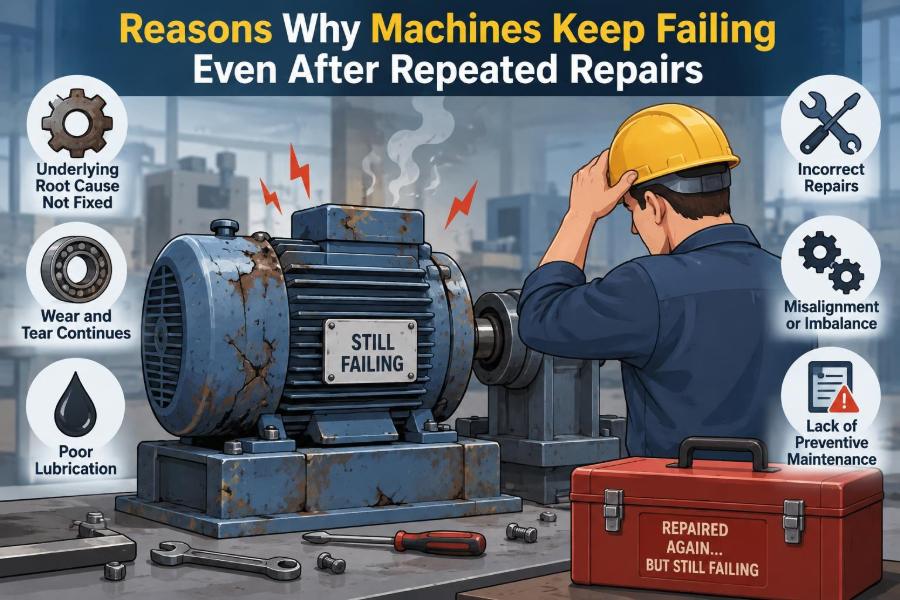

A production line stops halfway through a shift. A pump that received a new bearing last month is vibrating again. A vehicle returns to the workshop with the same warning light that was supposedly fixed. These situations are frustrating because the repair may have been performed correctly—yet the machine still fails.
Repeated breakdowns waste more than spare parts. They consume production time, expose technicians to rushed troubleshooting, reduce confidence in maintenance, and can turn a manageable defect into damage to shafts, housings, gears, or structures.
The usual explanation is that a component was “bad.” Sometimes that is true. More often, however, the failed component is a symptom of a problem elsewhere: poor lubrication, incorrect alignment, unstable electrical supply, an unsuitable operating condition, or an unaddressed design limitation.
Reliable repair starts by asking a harder question than “What part failed?” It asks, “What physical process made that part fail?”
🔁 A Repair Is Not Automatically a Root-Cause Fix
A repair restores function. A root-cause fix removes, controls, or redesigns the condition that produced the failure. Replacing a broken coupling, for example, restores torque transmission, but it does not correct the shaft misalignment that overloaded the coupling.
This distinction explains many repeat failures. The visible damage is repaired, the machine runs, and the underlying load, temperature, contamination, or control error remains active.
🧩 The Failed Part Is Often the Messenger
Components fail in recognizable ways. A bearing may show heat discoloration, pitting, brinelling, cage damage, or contamination marks. A fuse may open because of a transient overload, a short circuit, or simply an undersized selection.
Those patterns contain evidence. Treating every failed part as the cause is like replacing a thermometer because it reports a fever. The part may be defective, but its condition must be interpreted before a replacement is installed.
🔍 Root Cause, Failure Mode, and Symptom
These three terms are useful because they prevent vague troubleshooting. A symptom is what people observe, such as noise, leakage, overheating, or low output. A failure mode is the physical way the item stopped performing its function, such as fatigue cracking or insulation breakdown.
The root cause is the condition that initiated or sustained that failure mode. For example, excessive belt tension can create high radial bearing load; bearing fatigue is the failure mode; vibration and bearing noise are symptoms.
| Level | Example in a motor-driven pump | Useful question |
|---|---|---|
| Symptom | High vibration and hot bearing housing | What is happening? |
| Failure mode | Bearing raceway damage | How did the part fail? |
| Root cause | Misalignment or improper lubrication | Why did that damage develop? |
📋 Repeating the Same Job Repeats the Same Result
A common maintenance loop is simple: failure occurs, the team replaces the familiar part, production resumes, and the same part fails again. The speed of this response can look efficient because downtime is short in the moment.
But if no condition is measured or changed, the repair merely resets the clock. Repeated work orders for the same asset, component, and symptom should be treated as a signal that the maintenance strategy needs review.
📐 Misalignment Creates Hidden Loads
Misalignment occurs when connected rotating shafts do not share the intended centerline or angle. It can be angular, parallel (offset), or a combination of both. Flexible couplings tolerate limited movement; they do not make large alignment errors harmless.
Misalignment increases forces on couplings, bearings, seals, and shafts. It may also produce vibration at characteristic rotational frequencies, but measurement is preferable to guessing from sound alone.
Alignment can change after installation as a machine warms. This is called thermal growth. A cold alignment that appears acceptable may become poor at operating temperature if expected movement was not considered.
🦶 Soft Foot Undermines Accurate Alignment
Soft foot exists when one or more machine feet do not sit evenly on the base. Tightening the hold-down bolts bends the machine frame, changing the shaft position and introducing stress.
A technician can align a machine carefully, then lose that alignment as bolts are tightened or as the base settles. Checking each foot, correcting gaps with suitable shims, and confirming bolt-tightening effects are essential before final alignment.
⚖️ Imbalance Shakes Components Apart
Rotating imbalance occurs when mass is not distributed evenly around a shaft’s axis. Fans, impellers, grinding wheels, and rotors can become unbalanced through material buildup, erosion, missing hardware, or poor repair work.
The resulting centrifugal force rises sharply with speed. A small mass error that seems harmless at low speed can create substantial vibration at operating speed, shortening bearing life and loosening fasteners.
🌊 Resonance Amplifies an Otherwise Modest Problem
Every structure has natural frequencies at which it prefers to vibrate. Resonance occurs when a forcing frequency—often related to shaft speed, blade passing, or reciprocating motion—approaches one of those natural frequencies.
In this condition, a machine can vibrate severely even if its imbalance or misalignment is not extreme. Replacing bearings will not solve a flexible base, weak pipe support, loose guard, or operating speed that excites a structural resonance.
🛢️ Wrong Lubrication Is Not Just “Low Oil”
Lubricant must provide an adequate film between moving surfaces, carry heat away, protect against corrosion, and often transport contaminants to a filter. Using the wrong viscosity can leave that film too thin or create excessive drag and heat.
Grease selection also matters. Base-oil viscosity, thickener compatibility, operating temperature, load, and speed all affect suitability. A grease that works well in a slow, heavily loaded bearing may be unsuitable for a high-speed electric motor.
💉 Overgreasing Can Be as Damaging as Undergreasing
More grease is not a universal safety margin. Excess grease can churn, heat up, and force lubricant past seals. In some motor bearings, it can contaminate windings or create enough heat to degrade the grease quickly.
Effective lubrication specifies the right product, quantity, interval, application method, and cleanliness level. A grease gun without a measured route can turn preventive maintenance into a source of variation.
🧹 Contamination Starts a Wear Cycle
Dirt, water, process material, and metal particles can enter lubricated systems through damaged seals, open breathers, poor storage, careless filling, or washdown exposure. Even particles smaller than the eye can scratch precision surfaces and disturb lubricant films.
Wear then produces more debris, which accelerates further wear. This self-reinforcing cycle is why clean transfer containers, filtered filling, sealed storage, and appropriate breathers can matter as much as the lubricant itself.
🌡️ Heat Changes Materials and Clearances
Excess heat reduces lubricant viscosity, ages elastomers, weakens insulation, changes clearances, and can distort components. It is often an effect of another issue—overload, friction, restricted cooling, poor electrical connection, or incorrect settings.
Temperature should be interpreted in context. A warm gearbox may be normal for its duty, while a rapid rise from its usual operating trend deserves investigation. Comparing similar machines and tracking change over time is usually more useful than relying on a single surface reading.
⚡ Electrical Problems Can Look Mechanical
Motors may overheat or vibrate because of voltage imbalance, loose terminals, phase loss, incorrect protection settings, harmonic distortion, or rotor and stator faults. A mechanical team may repeatedly replace bearings when the actual driver is electrical stress.
Electrical checks should include safe verification of supply condition, current balance, terminal condition, insulation condition where appropriate, and motor loading. These tasks require qualified personnel and suitable procedures; live electrical work carries serious hazards.
🔌 Variable-Speed Drives Need System-Level Thinking
Variable-speed drives offer excellent control, but they change the operating environment. A pump or fan may spend more time at low speed, high speed, or near a structural resonance than it did on fixed-speed operation.
Drive output can also introduce voltage characteristics that require attention to motor insulation, cable arrangements, grounding, and bearing-current mitigation in suitable applications. The correct solution depends on the whole motor-drive-cable system, not on the drive alone.
🏋️ Operating Beyond the Design Duty
Machines are selected for a range of load, speed, pressure, flow, temperature, and environment. Production changes can quietly push an asset outside that range: thicker product, higher discharge pressure, more starts per hour, or longer uninterrupted runs.
A repaired machine that is routinely overloaded is not being given a fair test. Verify actual operating duty against the manufacturer’s information and the current process requirement, rather than assuming the original selection still fits.
💧 Pumps Can Fail Because the System Changed
A pump does not operate independently of its piping system. Blocked strainers, altered valve positions, deposits in lines, changed liquid temperature, air ingress, or a modified tank level can move the operating point away from its intended range.
Cavitation is a notable example. When local pressure falls low enough for vapor bubbles to form and then collapse, surfaces may erode and vibration may rise. The sound is sometimes described as gravel-like, but diagnosis should rely on process conditions and inspection, not sound alone.
🌬️ Fans and Compressors Also Have Unstable Zones
Fans can operate near stall, while compressors can experience surge under unsuitable system conditions. These conditions may cause pulsation, noise, temperature rise, and fluctuating loads.
Changing a damper, filter arrangement, duct layout, or control setting can alter performance dramatically. When failures follow a process modification, review the full flow system before blaming the rotating assembly.
🔩 Incorrect Fits and Assembly Damage Parts Early
Precision components depend on correct fits, surfaces, and handling. Driving a bearing through the wrong ring, striking it directly, using a damaged shaft journal, or installing it with the wrong interference fit can introduce damage before the machine starts.
Cleanliness matters during assembly too. A new seal installed over a sharp keyway without protection may be cut. A gasket surface scraped carelessly may leak even with a new gasket. “New” does not mean “correctly installed.”
🧰 Torque, Fasteners, and Joint Integrity Matter
Bolted joints work by clamp force. Too little torque can allow movement, fretting, leakage, and fatigue; too much can stretch bolts, crush gaskets, or damage threads. Lubrication on threads also changes the relationship between applied torque and resulting clamp load.
Use the specified tightening method where available, follow a suitable sequence for flanges and covers, and inspect mating surfaces. Randomly tightening bolts until they “feel right” creates inconsistent joints.
📦 Spare Parts Can Be Correctly Named but Wrong
Part numbers, revisions, materials, seal compounds, internal clearances, and dimensional tolerances may differ even when parts look nearly identical. A bearing with an unsuitable internal clearance or a seal material incompatible with the fluid can fail quickly.
Counterfeit, poorly stored, damaged, or expired components create additional risk. Critical spares need traceable identification, protected storage, and verification against the equipment documentation—not just a familiar appearance.
🧪 Material and Chemical Compatibility Are Easy to Miss
Process fluids, cleaning agents, humidity, temperature, and ultraviolet exposure can attack polymers, coatings, seals, and metals. A seal may swell, harden, crack, or lose strength when exposed to an incompatible chemical.
Corrosion can also concentrate stress at pits or crevices, making fatigue cracks more likely. If a failure follows a change in chemical, washdown practice, or ambient environment, material compatibility deserves specific attention.
🧠 Intermittent Faults Defeat Snapshot Troubleshooting
Some problems appear only at a particular temperature, load, speed, humidity, or phase of a production cycle. If inspection occurs after the machine has cooled or been unloaded, the evidence may disappear.
Capture conditions when the fault occurs: operating speed, pressure, flow, current, temperature, vibration, alarm history, operator observations, and recent process changes. Time-stamped data turns a vague intermittent complaint into a testable pattern.
📊 Condition Monitoring Finds Trends Before Failure
Condition monitoring does not replace inspection or skilled judgment, but it helps reveal deterioration. Vibration analysis can identify patterns associated with imbalance, misalignment, looseness, and bearing defects. Oil analysis can indicate contamination, wear debris, and lubricant condition.
Thermography, ultrasonic testing, motor-current analysis, and routine process data can also be useful. The best technique depends on failure consequences, machine type, access, and the capability to interpret results; collecting data without review adds little value.
🗂️ Maintenance History Must Be Usable Evidence
Work orders often say only “replaced bearing” or “repaired leak.” That record is too thin to support recurring-failure analysis. A useful history records the exact component, location, observed damage, measurements, lubricant used, operating state, and corrective action.
Photographs of failed parts, retained samples where practical, and consistent failure codes make patterns visible. If the same drive-end bearing fails three times but the records do not distinguish drive end from non-drive end, the most useful clue has been lost.
🧭 Use a Structured Root-Cause Investigation
Root-cause analysis need not be a long meeting for every minor issue. The depth should match safety risk, production impact, repair cost, and recurrence. For meaningful repeat failures, a disciplined sequence prevents premature conclusions.
- Define the failure clearly: what function was lost, when, and under what conditions?
- Preserve evidence before cleaning, dismantling, or discarding parts.
- List plausible causes across mechanical, electrical, process, human, and environmental categories.
- Test causes with measurements, inspection, records, and controlled checks.
- Implement corrective actions that address verified causes.
- Confirm effectiveness through follow-up operation and trend data.
Methods such as the “five whys” can be helpful, but they are not substitutes for evidence. Repeatedly asking “why” can still lead to an unsupported answer if no measurements or physical observations are used.
🛑 Avoid the Most Common Repair Traps
Several habits keep machines trapped in repeat-failure cycles:
- Replacing the most visible damaged part without inspecting connected components.
- Changing several variables at once, making it impossible to know what helped.
- Ignoring operating changes because “the machine used to run fine.”
- Using generic parts or lubricants without checking specifications.
- Closing a work order before confirming stable operation.
- Accepting recurring alarms or vibration as normal background noise.
Urgent repairs are sometimes unavoidable. Even then, the emergency repair should be followed by a planned investigation once the asset is safe and production is stabilized.
👥 Operators and Technicians See Different Clues
Operators notice changes in sound, smell, response, product quality, and process behavior long before a component may visibly fail. Technicians bring diagnostic methods and knowledge of component damage. Reliability improves when both observations are recorded and respected.
A useful handover describes what changed, not merely that “the machine is acting up.” For example: “vibration begins after 20 minutes at high flow and falls when the discharge valve is partially closed” is far more actionable than “pump is noisy.”
🦺 Safety Must Not Be Sacrificed for Fast Recovery
Recurring failures can tempt teams to bypass guards, defeat interlocks, work on energized equipment, or make adjustments near rotating parts. These choices can convert an equipment problem into an injury risk.
Apply lockout/tagout or the applicable energy-isolation procedure, verify zero energy where required, use approved lifting methods, and follow site-specific safety rules. Diagnostic work must be planned so that measurements do not expose people to avoidable hazards.
💰 Choose Corrective Actions by Risk and Value
Not every repeat failure justifies redesigning an entire system. A low-consequence item may be managed with a better spare, improved inspection, and a scheduled replacement. A safety-critical or production-critical failure may justify alignment upgrades, filtration improvements, redesign, monitoring, or vendor engineering support.
Consider the total consequence: downtime, quality losses, collateral damage, labor, safety exposure, and lost opportunity. The cheapest part replacement is not necessarily the lowest-cost decision over the asset’s life.
✅ Confirm That the Fix Actually Worked
A corrective action is a hypothesis until operating evidence supports it. After a repair, establish a baseline for relevant measurements—such as vibration, bearing temperature, motor current, pressure, or leakage—and review the machine through representative duty cycles.
If the original symptom returns, do not label the repair a success because the machine ran briefly. The required confirmation period depends on the failure mechanism: some defects recur within hours, while fatigue-related issues may take much longer to reveal themselves.
🎯 The Core Principle: Repair the System That Caused the Failure
Machines keep failing after repeated repairs when maintenance addresses the damaged item but not the forces and conditions acting on it. Alignment, lubrication, contamination control, electrical quality, installation practice, process duty, and information quality are all parts of one operating system.
The most reliable teams treat every recurring failure as a learning opportunity. They preserve evidence, verify assumptions, correct the proven cause, and check that the change holds under real operating conditions.
A lasting repair does not merely replace what broke; it removes the reason it was likely to break again. That mindset turns maintenance from repeated recovery into controlled reliability. ⚙️🔍🛠️