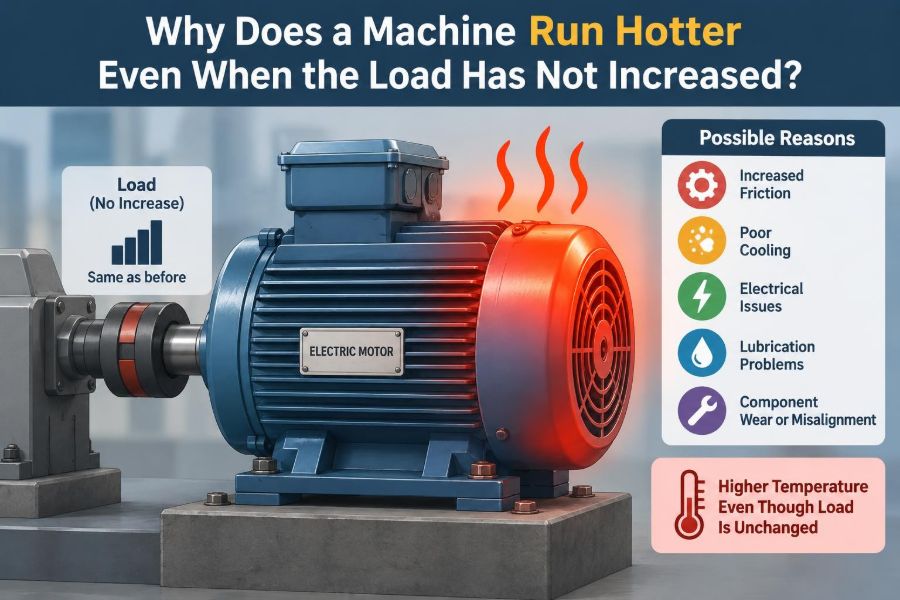

A production machine has been running the same product, at the same rate, for months. Then an operator notices that the bearing housing is too hot to touch, the motor feels warmer than usual, or a hydraulic unit needs more cooling time between cycles.
The first question is often, “Did the load increase?” Sometimes it did—but a hotter machine does not automatically mean it is doing more useful work. It may be converting a larger share of the same input energy into unwanted heat.
This distinction matters because excess temperature shortens lubricant life, accelerates insulation aging, changes clearances, and can turn a small defect into an unplanned shutdown. Temperature is not just a comfort issue; it is a condition signal.
Finding the reason requires more than reading a thermometer. It requires tracing where energy enters the machine, where it is lost, and whether the heat can still escape at the rate it is being generated.
🔥 Heat Is Usually a Sign of Energy Loss
Machines generate heat whenever energy is dissipated rather than delivered as useful output. Friction in a bearing, electrical resistance in a winding, fluid leakage across a valve, and belt slip all convert energy into heat.
A machine can therefore run hotter at unchanged external load if its internal losses rise. The driven conveyor, pump, or fan may appear to be doing exactly the same job, while the motor, gearbox, or hydraulic power unit is working less efficiently to do it.
⚖️ The Basic Energy Balance
At any moment, a machine’s temperature is governed by a simple balance: heat generated minus heat removed. If generation exceeds removal, temperature rises until a new, hotter equilibrium is reached—or until a protective device trips or a component fails.
This is why “same load” is not enough information. Two machines can transmit the same output power while one produces more internal heat, receives less cooling, or starts from a warmer surrounding environment.
📈 Same Load Does Not Mean Same Input Power
Mechanical load describes the useful resistance a machine overcomes. Input power includes that useful work plus losses. When efficiency declines, input power rises even though the output load has not changed.
For example, a motor-driven pump may maintain the same flow and pressure. If a bearing begins to drag or an impeller rubs lightly, the motor must supply extra torque. That extra electrical energy becomes heat in the motor and the faulty component.
🧲 Bearing Friction and Early Damage
Rolling-element bearings are a common source of unexpected heat. A healthy bearing has low rolling resistance, but damaged raceways, poor lubrication, contamination, excessive preload, or misalignment increase friction.
Early bearing damage may cause only a modest temperature rise. As surfaces deteriorate, however, friction and heat can reinforce each other: lubricant thins, protective films weaken, and wear accelerates.
- A hot spot localized near one bearing is more informative than a general temperature rise.
- Vibration measurements can reveal fault frequencies before the damage is visible.
- Comparing identical drive-end and non-drive-end bearings is often useful.
🛢️ Too Little, Too Much, or the Wrong Lubricant
Lubrication problems are not limited to an empty grease point. Too little grease or oil allows metal surfaces to contact more directly. Too much grease can create churning losses, where rolling elements repeatedly push through excess lubricant and heat it.
Viscosity matters as well. Oil that is too viscous wastes power through fluid drag, especially at startup. Oil that is too thin may fail to maintain an adequate separating film under load. The correct lubricant is selected for speed, temperature, load, bearing geometry, and service conditions.
💧 Contamination Changes the Friction Picture
Water, dust, process material, and wear particles can enter lubricants through failed seals, open breathers, careless filling practices, or condensation. Even small particles may dent rolling surfaces and create abrasive wear.
Contamination can also block passages and interfere with heat transfer. A cloudy gearbox oil sample, a clogged hydraulic filter indicator, or grease purging from a damaged seal should be treated as diagnostic clues, not isolated housekeeping issues.
📐 Misalignment Creates Hidden Side Loads
Couplings may still transmit rotation when shafts are offset, angularly misaligned, or improperly spaced. But misalignment imposes cyclic forces on bearings, couplings, and seals, increasing friction without necessarily changing the process load.
Thermal growth complicates alignment. A machine aligned accurately while cold may move as its frame, motor, or driven equipment warms. Alignment targets should account for expected operating temperature rather than relying only on cold measurements.
🪢 Belt and Chain Drives Can Waste Power
A slipping belt converts power directly into heat at the belt-pulley interface. Glazing, worn pulley grooves, contamination, inadequate tension, or a seized driven component can all contribute.
Chains create different losses. Tight chains overload bearings and increase articulation friction, while poor lubrication promotes wear and stiffness. A drive may still hold speed well enough to avoid obvious process complaints while its temperature steadily rises.
⚙️ Gear Mesh Problems Raise Churning and Sliding Losses
Gearboxes naturally produce some heat through tooth sliding, bearing losses, and oil churning. Heat increases when gears are poorly aligned, tooth surfaces are worn, backlash is incorrect, or the oil level is unsuitable.
Overfilling is a frequent misconception: more oil does not always mean better protection. If rotating gears dip too deeply into oil, they churn it like a mixer, consuming power and aerating the lubricant. Underfilling, conversely, can starve components. The correct level depends on the gearbox design and operating condition.
🌀 Internal Rubbing May Be Small but Serious
Rotating equipment can rub internally because of worn bearings, shaft deflection, thermal distortion, loose parts, incorrect assembly, or foreign material. A pump impeller grazing a casing or a fan wheel touching a shroud may initially create only slight drag.
Rubbing often leaves a recognizable combination of heat, abnormal noise, vibration, and metallic debris. Continuing operation can quickly turn a clearance problem into major rotor, seal, or casing damage.
🔌 Electrical Losses Can Rise Without Process Load Changes
Electric motors generate heat in winding resistance, rotor circuits, iron cores, bearings, and cooling fans. The mechanical load may be unchanged while electrical supply conditions increase these losses.
Loose terminals, poor connections, degraded insulation, voltage imbalance in three-phase systems, incorrect motor connections, and harmonics from certain power-electronic supplies can all affect heating. Electrical checks should be performed safely by qualified personnel using appropriate procedures and instruments.
⚡ Voltage Imbalance Is Disproportionately Harmful
In a three-phase motor, unequal phase voltages can produce unequal phase currents. The motor may continue to run and deliver its usual output, yet one winding carries more current and becomes hotter than the others.
The relevant question is not simply whether voltage is present, but whether phase-to-phase voltages and currents are balanced under operating conditions. A loose connection, damaged contactor, supply issue, or uneven circuit resistance can be the underlying cause.
🔄 Frequent Starts and Stops Add Thermal Stress
Starting a motor requires high current, and repeated acceleration consumes energy even if the steady process load is unchanged. A machine that once ran continuously may run hotter after a control change that introduces frequent cycling, jogging, plugging, or short restarts.
Similarly, a conveyor that starts with material already on it may have the same average throughput but greater peak demand during every start. Trend data should include operating pattern, not just load at a single instant.
🌡️ Ambient Temperature Changes the Cooling Margin
A machine releases heat to its surroundings through convection, radiation, and sometimes a dedicated cooler. When room temperature rises, the temperature difference driving that heat transfer becomes smaller.
The machine may not be generating any more heat at all; it may simply be unable to reject the same heat as effectively. Seasonal weather, a nearby furnace, a closed enclosure door, or relocated equipment can alter the ambient conditions enough to matter.
🌬️ Blocked Airflow Is a Common Cooling Failure
Motor cooling fins, fan covers, radiator cores, heat exchanger surfaces, and electrical cabinet filters collect dust, fibers, oil mist, and debris. These deposits act as insulation and reduce airflow.
A missing, damaged, or incorrectly rotating cooling fan can have a similar effect. Check the full air path: cool air must enter, pass over heat-producing surfaces, and leave without being recirculated back to the intake.
💦 Water and Oil Coolers Need Their Own Inspection
Hydraulic systems, compressors, and process equipment often depend on heat exchangers. Scale on the water side, fouling on the oil side, restricted flow, a stuck thermostatic valve, or an undersized replacement cooler reduces heat rejection.
Cooler performance should be assessed with temperatures and flow conditions, not appearance alone. A clean-looking unit can still have poor internal flow, while a dirty exterior may be only part of the problem.
🏠 Enclosures Can Trap Their Own Heat
Acoustic covers, guards, cabinets, and machine rooms protect people and equipment, but they can also restrict ventilation. A modification that improves noise control or keeps out contamination may unintentionally create a hot air pocket.
Heat from several devices can accumulate in the same enclosure. A variable-frequency drive, transformer, motor, and hydraulic unit may each be within its own limit, yet together push cabinet or room temperature above the intended design condition.
🧯 Hydraulic Throttling Turns Pressure Drop into Heat
In hydraulic equipment, pressure losses across restrictions become heat in the fluid. A partially closed valve, sticking spool, clogged line, undersized passage, or incorrect relief-valve setting can raise oil temperature even when cylinder force and production output remain unchanged.
Internal leakage is another source. Oil slipping across worn pump clearances, valve spools, or cylinder seals does no useful external work. It circulates energy back into the fluid as heat.
🚿 Pump Recirculation and Cavitation Add Losses
A centrifugal pump can run hot when flow is far from its intended operating region. Excessive recirculation, a throttled discharge, a blocked suction strainer, or a partially closed suction valve can create internal turbulence and heating.
Cavitation occurs when local pressure falls low enough for vapor bubbles to form and collapse. It may sound like gravel passing through the pump and can erode surfaces. It is not merely a noise problem; it disrupts flow and damages components.
🔍 Temperature Location Changes the Diagnosis
A single temperature reading has limited meaning without location, method, and comparison. A hot motor frame suggests a different set of causes than a hot terminal box, bearing cap, gearbox sump, or hydraulic reservoir.
Use repeatable measurement points and record operating state. Infrared instruments are useful for screening, but surface finish, emissivity, viewing angle, and reflected radiation can affect readings. Contact sensors or installed probes may be needed for confirmation.
📊 Trend Data Is More Valuable Than One Number
Every machine has a normal operating temperature range influenced by design, load, ambient conditions, and measurement location. The most useful warning is often a sustained deviation from that machine’s own baseline.
Record temperature alongside speed, current, pressure, flow, ambient temperature, and maintenance events. A trend can show whether overheating began after a lubricant change, alignment job, production schedule change, or ventilation modification.
🧪 Use Multiple Condition Indicators
Temperature is a broad symptom, so it works best with other evidence. Vibration can identify mechanical faults, oil analysis can reveal contamination and wear, ultrasound can detect some friction and air leaks, and electrical tests can expose supply or winding issues.
| Observation | Possible direction for investigation |
|---|---|
| One bearing hotter than similar bearings | Lubrication, preload, contamination, alignment, bearing damage |
| Whole motor hotter with elevated current | Mechanical drag, electrical supply, frequent starts, cooling failure |
| Hydraulic reservoir temperature rising | Throttling, internal leakage, cooler performance, fluid condition |
| Hot gearbox with foamy oil | Overfill, wrong viscosity, air ingress, gear or bearing distress |
These are diagnostic starting points, not proof. A reliable conclusion comes from evidence that agrees across measurements.
🧭 Separate Heat Generation from Heat Rejection
A practical investigation begins with a useful question: did the machine start making more heat, or did it lose its ability to shed heat? This prevents a common mistake—replacing a cooler when the real issue is rising friction, or replacing a bearing when a blocked fan is responsible.
- Confirm the temperature rise with a consistent method.
- Compare current process conditions with the historical baseline.
- Inspect cooling paths, lubricant condition, and obvious mechanical changes.
- Measure relevant current, vibration, pressure, flow, or speed.
- Correct the verified cause and confirm that the trend returns to normal.
🛠️ Avoid Fixes That Only Hide the Symptom
Adding a larger fan, lowering a trip setting, or increasing lubricant quantity may reduce an immediate concern, but each can conceal the mechanism creating the heat. Extra cooling can be appropriate when process conditions genuinely changed, yet it is not a substitute for correcting a rubbing rotor or leaking hydraulic valve.
Likewise, simply reducing load may not solve an electrical imbalance or blocked ventilation path. A repair should restore the intended energy path and cooling design, then be verified under normal operation.
⚠️ Know When Continued Operation Is Unsafe
Rapid temperature rise, smoke, burning odor, visible lubricant breakdown, severe vibration, unusual rubbing noise, repeated protective trips, or a hot electrical connection warrant escalation under the site’s safety procedure. Do not touch energized or rotating equipment to “feel” its temperature.
Shutdown decisions depend on equipment criticality, manufacturer limits, monitoring data, and site rules. Where there is uncertainty, trained maintenance and electrical personnel should assess the equipment rather than relying on an informal temperature judgment.
🧰 Preventive Work Protects Efficiency
Effective prevention is not just a calendar of lubrication tasks. It includes correct lubricant storage, contamination control, alignment verification, cooling-system cleaning, torque checks on electrical connections, and baseline condition monitoring.
After maintenance, confirm details that are easy to overlook: correct oil level, correct grease quantity, fan direction, guard clearances, coupling setup, and restored airflow. Many post-maintenance temperature problems arise from these practical details.
📝 Build a Useful Temperature Baseline
For critical assets, document normal temperatures at defined points after the machine has reached stable operation. Note the sensor type, location, ambient temperature, speed, process state, and any cooling equipment in service.
A baseline does not eliminate judgment, but it gives maintenance teams a defensible reference. It also makes handovers clearer: “bearing housing is 12 degrees above its normal trend at comparable conditions” is more useful than “it feels hot.”
🧠 The Core Principle: Follow the Lost Energy
When a machine runs hotter without an apparent load increase, look for a change in losses, cooling, or operating pattern. Friction, electrical resistance, fluid leakage, churning, and restricted heat transfer are all routes by which the same machine can reach a higher temperature.
The disciplined approach is to identify where the energy is being dissipated and why it is no longer leaving the machine fast enough. That approach turns temperature from a vague alarm into evidence that can guide inspection, maintenance, and safer decisions.
A hotter machine at the same load is usually telling you that its energy balance has changed—not that temperature itself is the failure. Read the trend, inspect the energy path, and correct the cause before small losses become expensive damage. ⚙️🌡️🔧