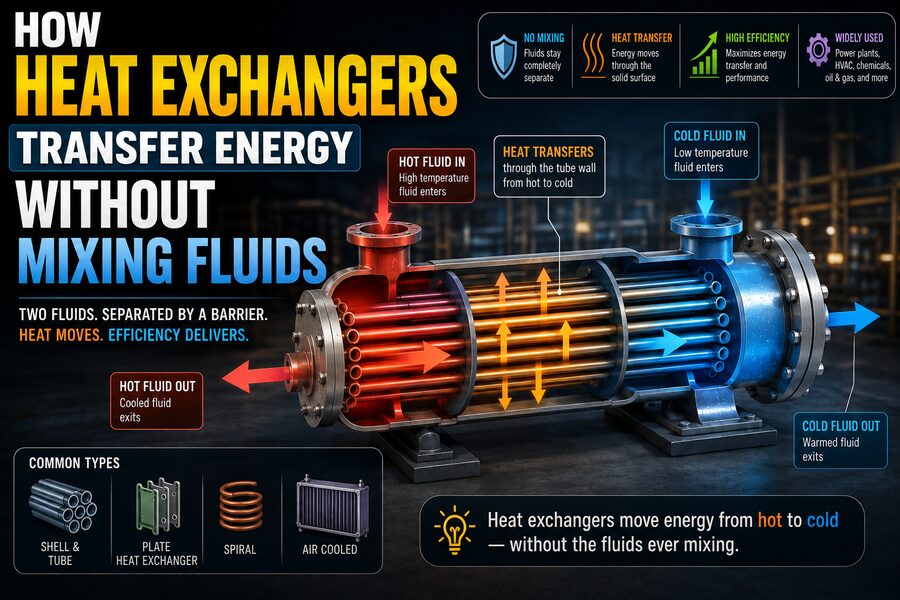

Heat exchangers are among the most important devices in modern engineering. They are used in power plants, ships, cars, air conditioners, refrigerators, chemical factories, data centers, oil refineries, food-processing facilities, and even household water heaters.
Their purpose sounds simple:
Transfer heat from one fluid to another without allowing the two fluids to mix.
That capability is extremely useful. Hot engine coolant can transfer energy to seawater without saltwater entering the engine. Steam can heat a chemical process without contaminating the product. Refrigerant can absorb heat from indoor air without leaking into the room.
The secret is a carefully designed solid barrier, usually made of metal, that separates the fluids while allowing thermal energy to pass through it. 🔥➡️❄️
Understanding how this works requires three important ideas: convection, conduction, and temperature difference.
🧠 What Is a Heat Exchanger?
A heat exchanger is a device that allows thermal energy to move between two or more fluids at different temperatures.
A fluid may be:
- 💧 Water
- 🛢️ Oil
- 🌬️ Air
- ♨️ Steam
- ❄️ Refrigerant
- 🧪 Chemical solution
- 🔥 Combustion gas
The fluids usually travel through separate passages.
A metal wall lies between them.
The hot fluid transfers energy to the wall, heat conducts through the wall, and the cooler fluid absorbs that energy from the other side.
The fluids therefore exchange heat, but not their actual material.
A simplified process is:
Hot fluid → metal wall → cold fluid
The wall becomes the pathway for thermal energy while remaining the physical barrier that keeps the fluids separate.
🔥 Heat Naturally Moves From Hot to Cold
Heat transfer occurs because of a temperature difference.
If one fluid is at 100°C and another is at 20°C, thermal energy naturally tends to move from the hotter fluid toward the colder one.
This process continues as long as a useful temperature difference exists.
The larger the temperature difference, the stronger the potential driving force for heat transfer.
Eventually, if two isolated substances were allowed enough time to exchange energy, they would approach the same temperature.
Heat exchangers take advantage of this natural process but engineer it to happen efficiently and continuously.
🌬️ Step 1: Convection From the Hot Fluid
The first stage usually involves convection.
The hot fluid flows past a metal surface.
Thermal energy moves from the moving fluid into the wall.
For example, imagine hot engine coolant flowing through a metal tube.
The fluid particles near the tube surface transfer energy to the metal.
How efficiently this happens depends on factors such as:
- Fluid velocity
- Fluid properties
- Surface shape
- Turbulence
- Temperature difference
Faster or more turbulent flow can often improve heat transfer because it continually brings fresh hot fluid into contact with the wall.
🧱 Step 2: Conduction Through the Wall
Once heat reaches the metal wall, it moves through the material by conduction.
Metals are often used because they conduct heat efficiently.
Common heat-exchanger materials include:
- Copper
- Aluminum
- Stainless steel
- Carbon steel
- Titanium
- Nickel alloys
The choice depends on temperature, pressure, corrosion, cost, and fluid chemistry.
A thin metal wall generally transfers heat more easily than a thick one.
However, it must still be strong enough to resist pressure.
This creates an important engineering trade-off:
The wall should be thin enough for good heat transfer but strong enough to safely separate the fluids.
💧 Step 3: Convection Into the Cold Fluid
After heat passes through the wall, it reaches the cooler fluid on the opposite side.
Convection then transfers the energy from the metal surface into that fluid.
The cooler fluid warms up as it travels through the exchanger.
Meanwhile, the hot fluid cools down.
At no point do the fluids necessarily come into direct contact.
The entire energy-transfer path is:
Hot fluid → convection → wall → conduction → wall surface → convection → cold fluid
That simple chain explains the basic operation of most conventional heat exchangers.
🔄 Why the Fluids Do Not Mix
The physical barrier between the fluids prevents mixing.
For example, in a tube-based heat exchanger:
- Fluid A flows inside the tubes.
- Fluid B flows outside the tubes.
- Tube walls separate them.
The wall allows thermal energy to pass because atoms and electrons inside the material transfer energy.
But the wall does not allow the actual fluid molecules to pass through under normal conditions.
This is similar to holding a metal spoon in hot soup.
Your hand can eventually feel the heat travel through the spoon even though the soup itself never travels through the metal.
Heat moves.
Matter stays separated.
🔧 Shell-and-Tube Heat Exchangers
One of the most common industrial designs is the shell-and-tube heat exchanger.
It consists of a large cylindrical shell containing many smaller tubes.
One fluid flows through the tubes.
The second fluid flows around the outside of the tubes inside the shell.
The tube walls separate the fluids.
Why use many small tubes rather than one large pipe?
Because many tubes create a much larger surface area.
Greater surface area gives heat more opportunity to cross from one fluid to the other.
Shell-and-tube exchangers are widely used in:
- Oil refineries
- Power plants
- Ships
- Chemical factories
- Heating systems
- Industrial cooling systems
They can handle high pressures and temperatures and are relatively robust.
📚 Plate Heat Exchangers
A plate heat exchanger uses many thin metal plates instead of tubes.
The plates are stacked together so that hot and cold fluids flow through alternating channels.
A simplified arrangement might look like:
Hot | plate | Cold | plate | Hot | plate | Cold
The fluids remain separate because the plates and sealing system keep their channels isolated.
Thin plates offer excellent heat transfer because:
- The wall is very thin.
- Surface area is large.
- Flow passages can create turbulence.
Plate heat exchangers are widely used in HVAC systems, ships, food processing, refrigeration, and industrial cooling.
🌬️ Air-Cooled Heat Exchangers
Not every heat exchanger transfers heat between two liquids.
Some transfer heat between a liquid and air.
A car radiator is a familiar example. 🚗
Hot engine coolant flows through small tubes.
Metal fins attached to those tubes increase surface area.
Air passes across the fins.
Heat follows this path:
Hot coolant → tube wall → metal fins → air
The coolant and air never mix.
Fans may increase airflow when the vehicle is stationary or moving slowly.
Similar air-cooled heat exchangers are used in power plants, electronics, compressors, and industrial processes.
🌀 Why Fins Improve Heat Transfer
Air is generally not as effective at carrying heat as liquids.
Engineers compensate by increasing surface area.
Thin metal fins provide much more area for the air to contact.
A small tube alone might expose only a limited surface.
Attach hundreds of fins, and the effective surface area can increase dramatically.
This is why radiators, air-conditioner coils, and computer heat sinks often have many closely spaced fins.
↔️ Parallel Flow
The direction in which fluids travel strongly affects heat-exchanger performance.
In a parallel-flow exchanger, both fluids enter from the same end and travel in the same direction.
For example:
Hot → → →
Cold → → →
The temperature difference is largest near the inlet.
As both fluids move through the exchanger, their temperatures become closer.
This reduces the heat-transfer driving force near the outlet.
Parallel flow is simple, but it is often less thermally efficient than counterflow.
🔁 Counterflow
In a counterflow heat exchanger, the fluids travel in opposite directions.
For example:
Hot → → →
← ← ← Cold
This arrangement usually maintains a more useful temperature difference across the entire exchanger.
As a result, counterflow systems can often transfer more heat for the same surface area.
They can also allow the outlet temperature of the cold fluid to approach the hot-fluid inlet temperature more closely than a comparable parallel-flow arrangement.
Counterflow is therefore extremely common in efficient heat-exchanger design.
➕ Crossflow
In a crossflow exchanger, the fluids move roughly perpendicular to one another.
One stream may travel horizontally while another moves vertically across it.
Automotive radiators and many air-conditioning coils use crossflow arrangements.
Crossflow designs are especially useful when one fluid is air.
📐 Engineers Calculate Heat Transfer
A common simplified heat-exchanger relationship is:
Q = U × A × ΔT
where:
- Q = heat-transfer rate
- U = overall heat-transfer coefficient
- A = heat-transfer surface area
- ΔT = effective temperature difference
This equation reveals three major ways engineers can increase heat transfer:
- Increase the temperature difference.
- Increase the surface area.
- Improve the overall heat-transfer coefficient.
Real calculations are more sophisticated because temperatures change continuously through the exchanger.
Engineers often use methods involving the log mean temperature difference, or LMTD, or effectiveness-NTU calculations.
🌡️ What Is the Overall Heat-Transfer Coefficient?
The overall heat-transfer coefficient, U, represents how easily heat can move through the complete system.
It includes resistance from:
- Hot-fluid convection
- Metal-wall conduction
- Cold-fluid convection
- Fouling deposits
A high U value means heat moves relatively easily.
A low U value means greater resistance to heat transfer.
Engineers improve U through:
- Better materials
- Turbulent flow
- Thin walls
- Clean surfaces
- Appropriate fluid velocities
🧮 Why Surface Area Matters So Much
Suppose engineers want to transfer more heat without changing fluid temperatures.
One solution is to increase area.
That explains why heat exchangers contain:
- Many tubes
- Corrugated plates
- Fins
- Extended surfaces
An exchanger may look compact externally while containing a surprisingly large internal surface area.
Surface-area optimization is one of the core design challenges in thermal engineering.
🌊 Turbulence Can Improve Heat Transfer
Fluid near a wall can form a relatively slow-moving boundary layer.
That layer can resist heat transfer.
Turbulent flow continuously mixes the fluid.
Hot fluid farther from the wall is brought closer to the surface, while cooler fluid is moved away.
This often improves heat transfer dramatically.
Engineers may intentionally create turbulence using:
- Corrugated plates
- Baffles
- Higher flow velocity
- Special tube geometries
However, turbulence also increases pressure loss.
That means pumps may require more energy.
Once again, engineers must balance thermal performance with operating cost.
🧱 What Are Baffles?
Shell-and-tube heat exchangers often contain plates called baffles inside the shell.
Baffles force the shell-side fluid to change direction and flow across the tubes.
They provide two important benefits:
- Increased turbulence
- Better fluid contact with the tubes
Baffles can also mechanically support long tubes and reduce vibration.
Their spacing and shape strongly influence exchanger performance.
⚡ Pressure Drop Matters
Fluids lose pressure as they move through pipes, channels, valves, and heat exchangers.
This is called pressure drop.
Narrow channels and turbulent flow can improve heat transfer, but they also increase friction.
That means the pumps or fans must work harder.
Engineers therefore optimize both:
Heat transfer efficiency
and
Pressure-drop penalty
A theoretically excellent exchanger may be impractical if pumping it consumes too much energy.
🧼 Fouling Reduces Performance
Heat exchangers become less efficient when deposits accumulate on heat-transfer surfaces.
This is called fouling.
Possible deposits include:
- Mineral scale
- Rust
- Oil residue
- Biological growth
- Sediment
- Chemical deposits
Fouling adds an insulating layer.
Instead of heat passing directly through clean metal, it must cross additional material.
As a result, heat-transfer performance falls.
🐚 Fouling in Seawater Systems
Marine heat exchangers face particularly challenging conditions.
Seawater can contain:
- Salt
- Minerals
- Sand
- Shell fragments
- Biological organisms
Marine growth can partially block tubes or plate passages.
Engineers therefore use strainers, chemical treatment, anti-fouling systems, and regular cleaning.
A badly fouled cooler may no longer transfer enough heat even if pumps are operating normally.
🧽 How Heat Exchangers Are Cleaned
Cleaning methods depend on exchanger design and contamination.
Possible techniques include:
- Mechanical brushing
- Chemical cleaning
- High-pressure water
- Backflushing
- Plate disassembly
Some industrial systems are designed specifically to make maintenance easier.
Monitoring temperature and pressure trends can help engineers identify fouling before performance becomes unacceptable.
🔩 Corrosion Is Another Major Concern
The metal barrier separating the fluids must remain intact.
Corrosion can gradually weaken it.
This is especially important when one fluid is:
- Seawater
- Acidic chemical
- High-temperature gas
- Corrosive industrial solution
Engineers select materials accordingly.
For seawater service, titanium may be used because of its excellent corrosion resistance.
Stainless steels and special nickel alloys are used in other aggressive environments.
⚠️ What Happens If the Barrier Fails?
If a tube or plate develops a leak, the fluids may begin mixing.
That can be dangerous.
For example:
- Cooling water could contaminate lubricating oil.
- Chemical process fluid could enter cooling water.
- Refrigerant could leak.
- Seawater could enter an engine freshwater circuit.
Engineers therefore monitor for exchanger leakage.
Pressure differences are sometimes deliberately chosen so that if a small leak occurs, the less dangerous fluid moves into the more dangerous side rather than the reverse.
♨️ Condensers Are Heat Exchangers Too
A condenser is a heat exchanger in which a vapor releases heat and becomes liquid.
Power plants provide a major example.
After steam passes through a turbine, it enters a condenser.
Cooling water removes heat from the steam.
The steam turns back into water.
The cooling water and steam remain physically separated by metal tubes.
This allows the working water-steam cycle to remain relatively pure.
❄️ Evaporators Also Use Heat Exchangers
In refrigeration and air-conditioning systems, an evaporator absorbs heat.
Cold refrigerant flows through coils.
Warm air or liquid transfers energy into the refrigerant.
The refrigerant evaporates as it absorbs that heat.
Once again, heat crosses a solid barrier while the fluids remain separate.
This principle is central to:
- Refrigerators
- Air conditioners
- Heat pumps
- Industrial chillers
🏠 Heat Exchangers in Home Heating
Domestic boilers often use heat exchangers.
A burner heats combustion gases.
Those hot gases transfer energy through metal surfaces into water.
The water then circulates through radiators or underfloor heating.
Combustion gases remain separated from the household heating water.
This separation is essential for safety.
🚗 Heat Exchangers in Cars
A modern vehicle contains several heat exchangers.
Examples include:
- Engine radiator
- Air-conditioning condenser
- Air-conditioning evaporator
- Heater core
- Transmission oil cooler
- Intercooler
Each handles a different thermal task.
The vehicle’s front grille may therefore conceal several heat-exchanger layers stacked one behind another.
✈️ Aerospace Heat Exchangers
Aircraft also require thermal management.
Heat exchangers can cool:
- Engine oil
- Hydraulic fluid
- Cabin air
- Electronics
Weight is extremely important in aerospace engineering.
Aircraft heat exchangers therefore need excellent heat transfer while remaining compact and lightweight.
🖥️ Heat Exchangers in Data Centers
Modern data centers generate enormous amounts of heat.
Liquid cooling systems increasingly use heat exchangers to move that energy between separate loops.
For example:
Server coolant loop → heat exchanger → facility water loop
Keeping the loops separate allows each to use appropriate water chemistry, pressure, and equipment.
Heat exchangers are especially important in high-density computing and AI systems. 💻🔥
🧪 Chemical Plants Depend on Fluid Separation
In chemical processing, it is often essential that heating or cooling utilities never mix with the product.
A chemical reactor may need to be heated using steam.
Steam can circulate through a jacket or exchanger wall while the chemical remains inside its own vessel.
Similarly, cooling water can remove heat from a process without contaminating it.
This helps maintain product purity and process safety.
🥛 Food Processing Uses Hygienic Heat Exchangers
Food and beverage facilities use heat exchangers for:
- Milk pasteurization
- Juice processing
- Brewing
- Beverage cooling
- Food heating
Plate heat exchangers are especially common because they can provide excellent heat transfer and are available in sanitary designs.
The heating medium remains physically separated from the food product.
♻️ Heat Recovery Saves Energy
Heat exchangers do not only cool things.
They can also recover energy that would otherwise be wasted.
Suppose a factory discharges a hot fluid.
Instead of throwing that heat away, engineers can use a heat exchanger to warm an incoming cold stream.
This is called heat recovery.
Possible benefits include:
- Lower fuel consumption
- Reduced electricity use
- Lower operating cost
- Reduced emissions
Heat recovery is an important part of energy-efficient industrial design.
🌬️ Heat Recovery Ventilation
Buildings can also recover thermal energy from exhaust air.
During winter, warm indoor air leaving a building transfers heat to colder incoming fresh air.
The air streams remain separate.
This reduces the amount of energy needed to heat the incoming air.
In summer, the process can sometimes work in the opposite direction.
🔄 Regenerative vs. Recuperative Heat Exchangers
Most exchangers described so far are recuperative, meaning hot and cold fluids flow continuously on opposite sides of a separating wall.
Another type is the regenerative heat exchanger.
In some regenerative systems, a thermal storage material alternately absorbs heat from a hot stream and releases it to a cold stream.
Rotary heat wheels used in ventilation systems are one example.
These designs still aim to exchange thermal energy while controlling unwanted mixing.
📊 Effectiveness Measures Performance
Engineers sometimes describe heat-exchanger performance using effectiveness.
Effectiveness compares:
Actual heat transferred
with
Maximum theoretically possible heat transfer
A highly effective exchanger extracts more of the available thermal potential between the fluids.
However, increasing effectiveness may require:
- More surface area
- Larger equipment
- Higher cost
- Greater pressure drop
The most effective exchanger is therefore not always the most economical one.
🏗️ Why Heat Exchanger Design Is a Trade-Off
Engineers must simultaneously consider:
- Heat-transfer rate
- Pressure drop
- Material cost
- Equipment size
- Fouling
- Corrosion
- Maintenance
- Safety
- Fluid pressure
- Temperature
For example, increasing fluid velocity may improve heat transfer but also increase pump energy and erosion.
Making tubes thinner improves conduction but can reduce mechanical strength.
Adding more surface area improves performance but increases size and cost.
Heat-exchanger design is therefore an optimization problem.
🌟 Final Thoughts
Heat exchangers transfer thermal energy without mixing fluids by combining three basic physical processes:
Convection → Conduction → Convection
The hot fluid transfers heat to a solid wall through convection. Heat travels through the wall by conduction. The cooler fluid then absorbs the heat through convection.
Throughout the process, the metal wall keeps the fluids physically separated. 🔥🧱❄️
Engineers increase performance by using large surface areas, thin conductive materials, turbulence, counterflow arrangements, fins, tubes, and plates.
Different industries use different designs.
Shell-and-tube exchangers handle demanding industrial applications. Plate heat exchangers offer compact and efficient heat transfer. Radiators transfer heat into air. Condensers turn vapor into liquid, while evaporators absorb heat during refrigeration.
The same underlying principle appears in cars, ships, power plants, homes, factories, aircraft, refrigerators, and data centers.
What makes heat exchangers so valuable is their ability to move energy without moving contamination.
Hot seawater does not need to enter an engine cooling circuit. Steam does not need to mix with a food product. Refrigerant does not need to enter room air. Chemical processes can be heated or cooled while remaining isolated.
By allowing heat to cross a carefully engineered barrier while keeping fluids separate, heat exchangers make countless thermal systems safer, cleaner, and more efficient. 🌡️🔄⚙️