
A maintenance technician opens a guard after a machine stops, assuming the motion system is safe. A trapped hydraulic load slowly settles. A pneumatic cylinder still has compressed air behind it. Or an electric axis is disabled but can move if gravity back-drives the mechanism. Each situation can look “off” from the outside while retaining a different kind of hazardous energy.
This is why comparing hydraulic, pneumatic, and electric actuation is not simply a debate about which technology is modern, powerful, or inexpensive. It is a question about how a machine behaves during normal operation, a fault, maintenance, power loss, and recovery.
Industrial actuators turn energy into motion: lifting, clamping, pressing, positioning, rotating, cutting, and transferring parts. Their safety depends on the energy source, but also on the load, controls, guards, maintenance practices, and the people working around them.
There is no actuator type that is automatically safest in every application. The safer choice is the one whose hazards are understood, controlled, and verified for the specific machine task.
🧭 Start With the Right Safety Question
“Which is safer?” is too broad unless it is tied to a particular hazard. A small pneumatic gripper on a light assembly fixture presents a different problem from a hydraulic press, while a high-speed servo robot creates different risks again.
A better question is: which actuation system allows the machine’s foreseeable hazardous motions and stored energy to be controlled most reliably? That includes foreseeable misuse, component failures, loss of utilities, and maintenance work—not only ideal production conditions.
⚙️ What Actuation Means in a Machine
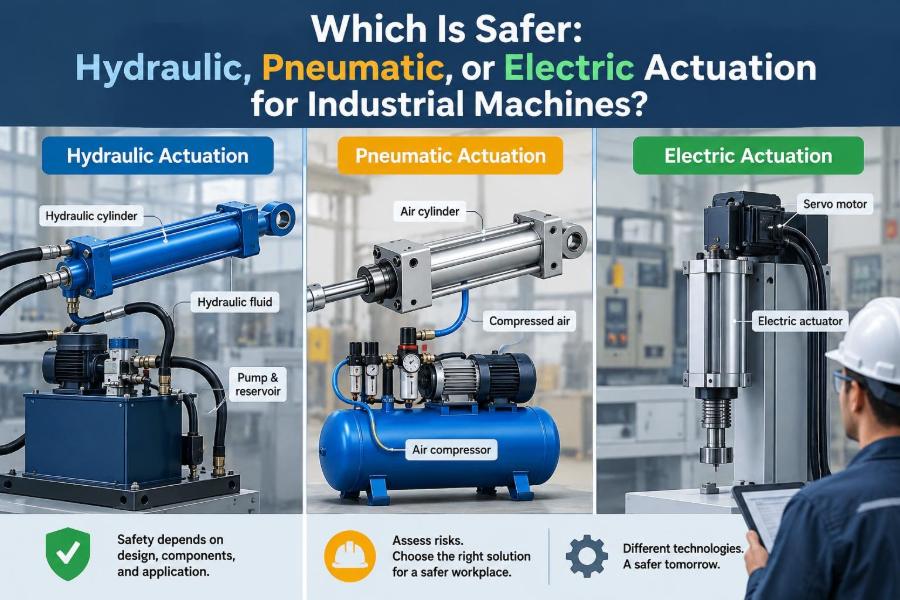
An actuator converts supplied energy into mechanical movement. Hydraulic cylinders use pressurized liquid, pneumatic cylinders use compressed gas, and electric motors use electrical energy to create rotary or linear motion.
Actuation includes more than the cylinder or motor. Pumps, compressors, valves, drives, hoses, wiring, brakes, sensors, controllers, and mechanical transmissions all influence the final safety behavior.
🔺 Safety Is a System Property
A hydraulic cylinder is not safe or unsafe by itself. It may be part of a carefully designed lifting circuit with load-holding valves, mechanical supports, guarded zones, and validated controls. The same cylinder in a poorly maintained circuit can create severe hazards.
Likewise, an electric servo can be exceptionally controllable, but software control alone does not stop a suspended load from falling if the motor torque disappears. The full machine architecture matters more than the label on the actuator.
💧 How Hydraulic Actuation Behaves
Hydraulic systems transmit power through pressurized fluid, commonly oil. A pump creates flow and pressure; directional and pressure-control valves route that energy to cylinders or hydraulic motors.
The major practical advantage is high force from relatively compact components. Hydraulics are therefore common where a machine must lift, form, compact, shear, or hold substantial loads.
Because liquid is only slightly compressible, hydraulic motion can feel stiff and forceful. That is useful for controlled pressing, but it also means stored pressure can release energy rapidly when a line, fitting, or component fails.
🌬️ How Pneumatic Actuation Behaves
Pneumatic systems use compressed air, usually supplied by a plant compressor. Valves admit or exhaust air from cylinders, rotary actuators, grippers, and other devices.
Air is compressible. That gives pneumatic systems a spring-like character: motion can be fast, cushioning can vary with load, and an actuator may continue moving briefly as air expands or vents. This behavior must be considered when setting speeds and safety distances.
Pneumatics often suit light, repetitive tasks such as sorting, part ejection, fixture clamping, and packaging movements. Their low component mass and comparatively simple installation can be helpful, but “lower force” does not mean harmless.
⚡ How Electric Actuation Behaves
Electric actuation covers a wide range of equipment: simple contactor-controlled motors, variable-speed drives, stepper motors, servo motors, linear motors, and electric cylinders. A controller and drive regulate motor torque, speed, and position.
Electric systems are often attractive when a task needs accurate positioning, programmable motion profiles, or synchronized axes. A servo can slow, accelerate, and stop with a precision that is difficult to obtain from a basic fluid-power circuit.
However, an electric drive introduces electrical, software, feedback, and mechanical transmission hazards. A motor may have low visible inertia but drive a heavy carriage through a gearbox, belt, ballscrew, or rack.
📊 The Core Hazard Comparison
| Safety consideration | Hydraulic | Pneumatic | Electric |
|---|---|---|---|
| Typical energy character | High force and stored fluid pressure | Stored compressed air and rapid motion | Electrical energy, rotating inertia, controlled torque |
| Power-loss behavior | Load may drift or settle without holding measures | Actuator may exhaust, coast, or change state | Motor torque may disappear; load may coast or fall |
| Major hidden hazard | Trapped pressure and hose failure | Residual pressure and unexpected cylinder movement | Stored electrical energy and unexpected restart |
| Common strength | Compact high-force motion | Simple, fast motion for lighter duties | Precise, programmable motion |
| Safety design focus | Load holding, pressure relief, containment | Energy isolation, exhaust control, speed limitation | Torque-off, braking, guarding, motion monitoring |
This comparison is a starting point, not a selection rule. Actual risk changes dramatically with force, speed, travel, orientation, tooling, access, and task frequency.
🧱 Force, Speed, and Mass Create the Hazard
Injuries result from mechanisms such as crushing, shearing, entanglement, cutting, impact, and ejection. The actuator contributes energy, but the tool and machine geometry determine how that energy reaches a person.
A slowly closing high-force hydraulic clamp can crush. A low-force pneumatic pusher can pinch fingers repeatedly. A fast electric axis can strike a person or trap them between a moving carriage and fixed structure.
When assessing risk, examine the complete movement: where it starts, where it can go, what it contacts, and whether a person can enter the danger zone.
🧯 Stored Energy Does Not Disappear When Motion Stops
One of the most persistent safety mistakes is equating stopped motion with zero energy. A stopped hydraulic system can retain line pressure. A pneumatic circuit can retain air in a cylinder or downstream volume. An electric drive can retain charge in internal energy-storage components after supply isolation.
Mechanical energy also remains. Elevated loads store gravitational potential energy, springs store elastic energy, and rotating flywheels or tooling retain kinetic energy.
Safe maintenance requires a method to isolate, release or restrain stored energy, and verify that the machine has reached a safe state. The exact procedure must match the machine rather than relying on a generic shutdown habit.
🛢️ Hydraulic Risks: Pressure, Leaks, and Falling Loads
Hydraulic fluid under pressure can escape through small defects at high velocity. A pinhole leak may be difficult to see and should never be checked with a hand. Escaping fluid can damage skin and create a serious medical emergency.
Leaks also create slip hazards, contamination, fire concerns in some environments, and reduced system performance. A hose rupture can cause a supported load to descend unless the circuit includes measures specifically designed to hold it.
For vertical or suspended loads, designers commonly consider devices such as load-holding valves, properly located pressure control, mechanical locks, or physical supports. The correct arrangement depends on the circuit and failure modes; adding a valve without understanding its placement can create new problems.
💨 Pneumatic Risks: Fast Motion and Uncontrolled Exhaust
Compressed air is often treated casually because it is familiar. Yet a cylinder can move with enough speed and force to pinch, strike, or eject a part, particularly when a load changes or pressure is restored after maintenance.
Opening an air supply can make a machine move unexpectedly if valves return to their normal state and cylinders are not designed for controlled restart. Exhausting the supply may also cause a vertical actuator or gripper to release a load unless a safe-loss-of-air behavior has been designed.
Compressed air should not be directed at the body or clothing for cleaning. Beyond the immediate physical hazard, it can propel chips and debris toward eyes and nearby workers.
🔌 Electric Risks: Motion, Shock, and Restart
Electric machines present two connected hazards: electrical exposure and mechanical motion. Damaged insulation, incorrect grounding, poor enclosure integrity, or work on energized components can expose personnel to electrical hazards.
At the mechanical level, a drive may execute commands quickly and repeatedly. Incorrect parameters, sensor faults, unintended commands, or a restart after an interruption can create hazardous motion if the control system and guarding are inadequate.
Disconnecting power is not always enough for a safe intervention. The machine may need time for stored electrical energy to dissipate, and suspended or overhauling loads may require a brake or mechanical restraint.
⬇️ Power Failure Is a Design Test
Ask what happens at the exact moment utility power, air supply, or hydraulic pump power is lost. This question often reveals the safest architecture.
A conveyor may safely coast to a stop. A vertical lift may not. A clamp may need to remain closed to prevent a part from dropping, or it may need to open to avoid trapping a person; the safe answer depends on the task and surrounding hazards.
Fail-safe does not always mean “everything stops.” It means the system transitions to a state that reduces risk for the credible scenario. That state must be defined deliberately, not assumed from actuator behavior.
🪜 Vertical Axes Need Special Attention
Gravity changes the risk picture. A vertical hydraulic cylinder can drift down, a pneumatic cylinder can lose supporting force, and an electric motor can be back-driven by the load after torque is removed.
Appropriate protective measures may include a rated mechanical brake, a counterbalance arrangement, a load-holding hydraulic circuit, a locking pin, or a designed support stand for maintenance. Redundancy may be needed where one failure could release a dangerous load.
Do not use a person’s body, improvised timber, or a control command as the only protection beneath raised equipment. Maintenance supports must be designed, rated, and used according to the machine procedure.
🛑 Stopping Is Not the Same as Making Safe
Industrial machines can stop in several ways: controlled deceleration, removal of drive torque, removal of fluid power, emergency stopping, or physical locking. These actions have different purposes.
An emergency stop is intended to reduce risk during an abnormal event. It is not automatically an energy-isolation device for maintenance. A normal stop may preserve pressure or keep a servo energized, while a maintenance isolation may intentionally remove or restrain several forms of energy.
Clear operating procedures should tell workers which stop function is appropriate for routine pauses, jam clearing, adjustment, and full maintenance.
🔒 Energy Isolation Must Cover Every Source
Effective lockout and tagout practices address all relevant energy paths. Depending on the machine, this can include electrical disconnects, pneumatic isolation valves, hydraulic isolation points, gravity restraints, spring releases, and stored-energy dissipation steps.
A useful procedure identifies the machine-specific sequence: shut down, isolate, lock, release or block stored energy, then verify. Verification matters because labels, valves, and indicators can be wrong or incomplete.
For example, closing an air valve may isolate the supply but leave pressurized air trapped downstream. A bleed or dump function may be necessary, but it must not cause an unrestrained load to move.
🧠 Controls Cannot Replace Physical Protection
Programmable controls can reduce risk through monitored states, limited speed, controlled restart, and fault detection. They are powerful tools, especially with electric motion systems, but they should not be the only barrier where a person can be crushed or cut.
Guards, interlocked access doors, safety-rated sensing, two-hand controls, mechanical stops, and safe distances provide layers of protection. The best choice depends on how frequently access is needed and whether the hazard can be fully enclosed.
Software is especially vulnerable to incorrect assumptions: a sensor can be misaligned, a parameter can change, or a signal can be interpreted incorrectly. Robust systems anticipate these faults rather than depending on perfect operation.
🧲 Brakes, Valves, and Locks Serve Different Jobs
It is tempting to call any device that stops movement a “safety brake.” In practice, a motor holding torque, a spring-applied brake, a hydraulic check valve, and a mechanical lock work in different ways and respond differently to faults.
Motor torque requires an energized and functioning drive. A brake may hold a shaft but not necessarily every component downstream of a gearbox or belt. A valve may hold pressure but can be affected by leakage, contamination, or hose failures outside its protected location.
Mechanical locking is often the most direct way to secure equipment for extended maintenance, but it must be designed so it can be engaged safely and cannot be bypassed accidentally.
🎯 Precision Can Improve Safety—With Limits
Electric servo systems can accurately control position, speed, and torque. That can reduce unnecessary impact, prevent overshoot, limit motion during setup, and enable slower collaborative or teaching modes where suitable.
Precision is not a substitute for a risk assessment. A precisely controlled machine can still apply dangerous force, and a position-feedback fault can defeat assumptions about where an axis is located.
Hydraulic proportional controls and pneumatic flow controls can also improve motion behavior. The safety benefit comes from predictable, bounded movement combined with independent protective measures.
🔧 Mechanical Design Often Decides the Outcome
Many hazardous motions can be reduced before control hardware is selected. Lowering the mass of a moving slide, relocating pinch points, adding a hard stop, enclosing a transmission, or choosing a less hazardous direction of travel can simplify the safety problem.
For example, if a fixture can clamp downward into a fixed nest rather than sideways toward an operator’s hand, access may be easier to protect. If an elevated tool can rest on a physical support in its parked position, dependence on active holding force is reduced.
This is a useful hierarchy: eliminate the hazard where practical, reduce it by design, then add controls, guards, and procedures.
🧰 Maintenance Changes Every Risk Profile
A machine that is adequately protected in production may be hazardous during troubleshooting. Guards may be open, personnel may be close to moving parts, and temporary tools or test leads may be in use.
Hydraulic maintenance introduces fluid cleanliness, hose condition, fitting integrity, and pressure-release concerns. Pneumatic maintenance requires attention to residual air and unexpected re-pressurization. Electric maintenance requires suitable electrical isolation, discharge time, and protection from mechanical movement.
Designers should make safe maintenance practical: provide accessible isolation devices, clear labels, gauge or status information where useful, designated blocking points, and procedures that do not encourage shortcuts.
🧪 Testing Must Include Credible Faults
A machine should not be judged safe only because it works during normal operation. Evaluate realistic faults such as a broken hose, lost air supply, sensor failure, stuck valve, lost feedback, drive fault, power interruption, or an operator opening an access point.
The goal is not to imagine every impossible event. It is to identify credible failures and determine whether the resulting motion, pressure, or restart can expose people to unacceptable risk.
Testing must be planned carefully. Intentionally creating faults in a live industrial machine can itself be hazardous, so verification methods should be developed by competent personnel with appropriate controls.
📐 Risk Assessment Guides Technology Selection
A structured risk assessment considers the severity of possible harm, how often people are exposed, whether they can avoid the hazard, and how likely the hazardous event is under expected conditions. It should be performed early enough to influence the machine layout.
For a high-force forming operation, hydraulics may remain the sensible choice, with robust guarding, load control, and maintenance isolation. For an indexing table that needs flexible positioning, electric actuation may offer clearer control options. For a low-load package diverter, pneumatics may be practical if speed and access are managed.
The assessment should be revisited when tooling, product size, cycle rate, control software, or maintenance methods change.
🏭 Where Hydraulics May Be the Safer Fit
Hydraulics can be a strong safety choice when high force is necessary and the machine can be designed to contain, control, and support that force. Their compact power density can avoid oversized mechanical transmissions or complex multi-motor arrangements.
They are often well suited to applications where stable force control matters, such as pressing or heavy lifting. But the design must explicitly address pressure relief, hose routing and protection, fluid leaks, load holding, and safe depressurization.
Hydraulics are not safer merely because they are robust. They are safer when their substantial energy is handled with equally substantial safeguards.
📦 Where Pneumatics May Be the Safer Fit
Pneumatics can be appropriate for short-stroke, lower-load, repetitive actions where a simple actuator is easier to guard and where a loss of air can be managed safely. They can also be useful in environments where avoiding hydraulic-fluid leaks is desirable.
However, using air because it seems benign is a common design error. Cylinder bore, supply pressure, linkage geometry, and speed can produce substantial pinching or impact hazards.
Use controlled speeds, consider rodless-cylinder and load-drop risks, protect access points, and define what happens when pressure is lost or restored.
🤖 Where Electric Actuation May Be the Safer Fit
Electric actuation often suits machinery that benefits from repeatable positions, controlled acceleration, low-energy setup modes, and diagnostic feedback. A well-designed electric system can reduce the need for continuously pressurized fluid circuits or compressed-air consumption.
It is particularly useful when motion must be coordinated across several axes or adjusted frequently for different products. But electric systems require disciplined management of drive parameters, braking behavior, feedback devices, and restart logic.
Choose electric actuation for its controllability when that control genuinely reduces the machine’s risk—not simply because the technology appears cleaner or newer.
⚠️ Common Selection Mistakes
- Choosing by force alone: A force calculation does not describe gravity, stored energy, access, or failure behavior.
- Assuming utility loss is safe: Loss of power, air, or pump flow can release rather than remove a hazard.
- Relying on one protective layer: A single valve, brake, sensor, or software function can fail.
- Ignoring maintenance access: Safe production guarding does not automatically create safe troubleshooting conditions.
- Adding safety parts late: Retrofitting guards and locks after layout decisions are fixed is often less effective and more awkward.
📝 Questions to Ask Before Choosing an Actuator
- What maximum force, speed, travel, and load must the machine handle?
- Can a person reach the hazard during operation, setup, clearing, or maintenance?
- What happens if power, air, pressure, feedback, or a control signal is lost?
- Does any load move vertically or retain energy after stopping?
- How will energy be isolated, dissipated, restrained, and verified?
- What independent safeguards remain if the primary actuator control fails?
- Can the system be inspected and maintained without creating a new exposure?
These questions turn actuator selection from a catalog comparison into a machine-safety decision.
👥 Competence, Procedures, and Communication
Even sound equipment can become unsafe when operators and maintenance personnel do not understand its states. Controls should clearly communicate whether the machine is ready, inhibited, faulted, isolated, or capable of restarting.
Training should explain real hazards rather than relying on vague warnings. Workers need to know, for example, that a gauge can show pressure, that a cylinder can still contain trapped air, or that a servo axis may need mechanical support before work begins.
Procedures should be specific enough to guide action but practical enough to be used under normal production pressure.
🔄 Retrofitting Older Machines
Older hydraulic, pneumatic, and electric machines can often be improved without replacing the entire actuation system. Useful upgrades may include better guards, clearer isolation points, protected hoses and cables, improved braking or load restraint, safer valve arrangements, and documented energy-control procedures.
A retrofit needs careful engineering review because changing one element can alter machine behavior. A faster valve, different motor drive, or added guard interlock may affect stopping distance, pressure response, or the ability to clear faults.
Do not treat a retrofit as a collection of parts. Treat it as a change to the safety function of the machine.
✅ The Practical Bottom Line
Hydraulic actuation is often best where compact high force is essential. Pneumatic actuation can be effective for simple, lighter-duty movements. Electric actuation excels when controlled, flexible, and precise motion is needed. None earns a universal safety ranking.
The decisive issue is whether the machine controls hazardous energy through appropriate design: predictable behavior under faults, protection against access, secure handling of suspended loads, effective energy isolation, and maintainable safeguards.
The safest actuator is the one integrated into a machine that remains safe not only when everything works, but also when something fails, stops, leaks, loses power, or needs service.
Choose the technology that fits the task, then engineer the protections around its real failure modes—not its best-case behavior. ⚙️🛡️🏭