
A modern factory can run through the night because its machines receive steady power through motors, drives, cables, and control systems. A railway locomotive, a cargo ship, or an excavator may seem equally self-contained: turn on the energy source, and useful motion follows.
Before steam power, most large-scale work depended on muscles, moving water, or wind. Those sources could be highly effective, but each tied production to a particular place, season, weather condition, or supply of labor.
The steam engine changed that relationship. It converted heat from fuel into controlled mechanical motion, making it possible to locate power where work was needed and to transmit that power to machines.
Its story is not simply one of a famous invention replacing older tools. It is a mechanical engineering story about energy conversion, materials, motion control, maintenance, safety, and the way one machine can reorganize an entire industrial system.
🌍 A World Powered by Nature and Muscle
Before widespread steam use, mills commonly relied on waterwheels, while windmills served suitable windy locations. Human and animal labor supplied motion for lifting, hauling, pumping, and many workshop tasks.
These methods were not primitive failures. A well-designed watermill could provide substantial and dependable power. The limitation was geographic: a mill needed adequate flowing water, and its output could vary with drought, freezing, floods, or competing users upstream.
Steam power did not instantly eliminate these systems. Instead, it offered a new option: a prime mover that could operate away from a river and deliver rotary or reciprocating motion more consistently when fuel and water were available.
🔥 The Essential Energy Conversion
A steam engine is a heat engine. It takes thermal energy released by burning fuel, uses that heat to create high-pressure steam, and expands the steam to push a piston or move a turbine.
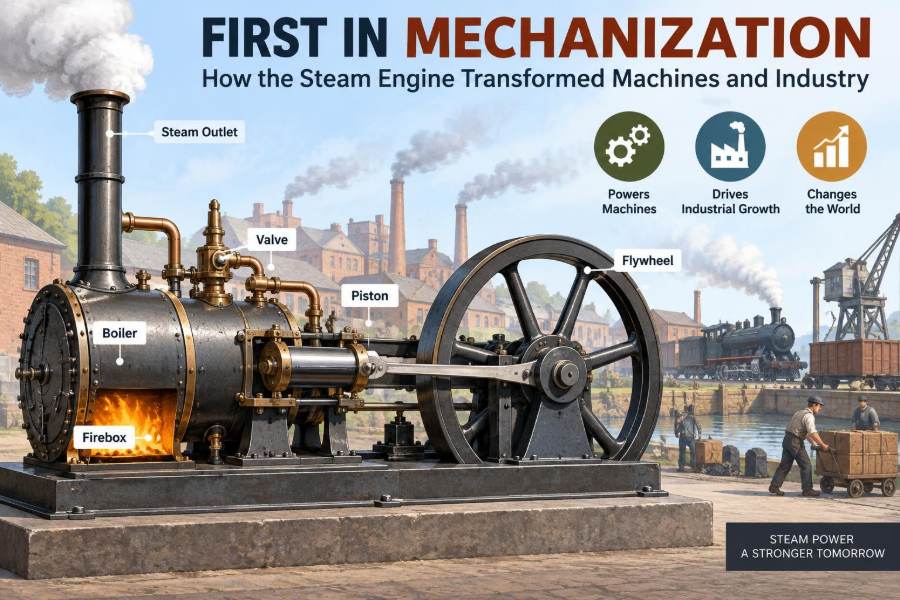
For the classic reciprocating engine, the basic chain is straightforward: fuel heats water in a boiler; the boiler produces steam; steam pressure acts on a piston; the piston turns a crank; and the crankshaft drives a wheel, pump, or line shaft.
Every step involves losses. Heat escapes through surfaces, exhaust steam retains energy, friction resists movement, and combustion may be incomplete. Steam engines were transformative not because they made energy conversion perfect, but because they made useful mechanical power controllable and scalable.
💧 Why Water Alone Was Not Enough
Waterwheels use the kinetic energy of moving water or the potential energy of falling water. Their output depends on flow rate and available head, meaning the vertical drop through which water falls.
A steam engine could be installed near a mine, port, textile district, or urban workshop rather than beside a suitable river. That flexibility mattered where the demand for work was growing faster than water-power sites could serve.
Steam still required water—both as working fluid and often for cooling—but a supply could be transported, stored, or pumped more readily than a river could be relocated.
⛏️ Mines Created an Early Engineering Need
Coal and metal mines became deeper as shallow deposits were exhausted. Groundwater was a severe obstacle: without pumping, shafts could flood and work could stop.
Early atmospheric steam engines were developed primarily to pump water from mines. Their motion was slow, but speed was not the central requirement. A large beam moving a pump rod could lift water repeatedly and make deeper extraction practical.
This created an important feedback loop. Coal helped power steam engines, while steam engines helped mines produce more coal. The loop did not remove the hard work or hazards of mining, but it increased the scale at which mines could operate.
🧪 From Atmospheric Engines to Higher Efficiency
Early engines used steam to create a vacuum beneath a piston after the steam condensed. Atmospheric pressure above the piston then did much of the pushing. These engines were robust, but repeatedly heating and cooling the same cylinder wasted fuel.
James Watt’s major improvement was the separate condenser. By condensing exhaust steam in a chamber separate from the main cylinder, the cylinder could remain hot while the condenser remained cool.
This principle reduced avoidable heat loss and improved fuel economy. The broader lesson remains central to thermal engineering: efficiency often improves when components that need different temperatures are physically separated.
🧱 The Boiler Was the Heart and the Hazard
A boiler is a pressure vessel that transfers heat from combustion gases to water. As water becomes steam, its volume expands greatly, creating pressure that can perform work.
That stored energy also creates danger. A boiler failure can release hot water, steam, and fragments with destructive force. Safe operation depends on sound design, appropriate materials, inspection, water-level control, pressure relief, and trained operators.
Engineers learned, sometimes through costly failures, that power equipment cannot be judged only by output. Containment, inspection access, and failure prevention are part of the design.
📏 Pressure, Force, and Piston Motion
Pressure is force distributed over area. In simplified form, the force on a piston equals the pressure difference across it multiplied by piston area. Higher pressure or a larger piston can therefore increase available force.
Real engines must also overcome friction, valve resistance, back pressure at the exhaust, and the inertia of moving parts. The useful force changes through the stroke because steam pressure changes as the steam expands.
This is why a drawing of a piston alone is incomplete. Performance comes from the whole system: boiler pressure, valve timing, cylinder geometry, exhaust conditions, lubrication, and the load connected to the crankshaft.
🔄 Turning Reciprocation into Rotation
A piston moves back and forth, but most machinery needs continuous rotary motion. The crank and connecting rod convert reciprocating motion into shaft rotation, much like the mechanism in many internal-combustion engines.
A large flywheel smooths speed fluctuations by storing rotational kinetic energy. During parts of the cycle when cylinder torque is lower, the flywheel releases energy and carries the crank through the less favorable position.
This conversion made steam engines broadly useful. A rotating shaft can drive gears, belts, pulleys, generators, wheels, and machine tools with relatively direct mechanical arrangements.
⚙️ The Beam Engine and Its Purpose
The beam engine used a large rocking beam, pivoted near its center. One end connected to the engine piston while the other connected to a pump rod or other load.
Its geometry suited mine pumping because it could transmit slow, powerful reciprocating motion down a shaft. The massive visible beam also provided a practical structure for balancing forces and guiding motion.
Beam engines were not the best solution for every application. Their size, mass, and primarily reciprocating output made them less convenient than later rotary engines where compact rotating power was needed.
🌀 Rotary Steam Power Changed Factory Layouts
Once engines could reliably produce rotary motion, they could run factory machinery through line shafts. A central engine turned a main shaft, which drove secondary shafts and individual machines through belts and pulleys.
This arrangement concentrated power in one engine room but distributed motion across a building. Factory floors were often organized around shaft routes, belt clearances, and the need to place machines within reach of the transmission system.
The system enabled coordinated production, but it imposed constraints. If the central engine stopped, much of the factory stopped. A loose belt or unguarded rotating shaft could also create serious injury risks.
🧵 Textile Mills Showed the System Effect
Textile production demonstrates why steam power mattered beyond any single machine. Spinning, weaving, carding, and finishing all benefited from repeatable rotary motion delivered at sustained speed.
A steam-powered mill could bring multiple processes together under one roof, coordinate material flow, and operate where transportation and labor access were favorable rather than only where waterpower existed.
That did not mean every steam-powered mill was automatically efficient or humane. Production capacity, workplace discipline, building design, labor conditions, and pollution all became intertwined with the new power system.
🚂 Railways Made Power Mobile
A stationary steam engine could power a factory, but a locomotive carried its boiler, fuel, water, engine, and driving wheels together. This made steam power mobile on a scale that transformed land transport.
Railways reduced the friction of rolling transport compared with many road vehicles, while rails guided heavy loads along predictable routes. Locomotives supplied the tractive effort needed to pull freight and passengers over long distances.
Rail operation required more than locomotives. It demanded track, bridges, signaling practices, workshops, water supplies, fuel handling, timetables, and standardized maintenance—an early example of technology becoming an integrated infrastructure system.
🚢 Steam Changed Marine Design
Wind-powered ships depended on weather and sailing skill. Steam propulsion offered schedule reliability and maneuvering control that were especially valuable in rivers, harbors, and regular passenger or cargo routes.
Early vessels used paddle wheels; later designs widely adopted screw propellers, which were generally better suited to open-water operation and protected below the hull. Marine boilers and condensers introduced their own engineering challenges, especially where fresh water was limited.
Coal storage took valuable space, and early marine engines could be fuel-intensive. Yet predictable propulsion changed route planning, port operations, and the economics of moving goods and people.
🏭 Steam Decoupled Factories from Rivers
The ability to place a factory near coal deliveries, workers, customers, or transport hubs was one of steam’s largest industrial consequences. Waterpower sites remained valuable, but they no longer defined every promising manufacturing location.
Urban industrial districts expanded partly because power could be brought in as fuel. This created opportunities for concentrated production and employment, while also concentrating smoke, ash, noise, traffic, and waste.
Mechanization therefore had a spatial dimension. A machine did not merely change the task at hand; it changed where buildings were constructed and how towns developed around them.
📈 Scale Came from Repeatable Power
Hand tools can be highly precise, and skilled craftspeople remained essential. The distinctive contribution of mechanized power was the ability to repeat a motion at a chosen rate for long periods.
That repeatability supported larger batches, more consistent dimensions in suitable processes, and the use of specialized machinery. It also made production more dependent on setup, calibration, tool condition, and the reliability of the power train.
In engineering terms, steam expanded the feasible operating envelope. It allowed designers to consider machinery whose required power exceeded what a worker, animal team, or local stream could conveniently provide.
🛠️ Machine Tools and Interchangeable Work
Steam engines required accurately made cylinders, pistons, valves, bearings, and shafts. Their production encouraged improvements in boring machines, lathes, planers, measuring practices, and metalworking knowledge.
Better machine tools then supported better engines and other machines. This mutual development is often overlooked: industrial change depended not only on the prime mover, but also on the ability to manufacture and repair its parts consistently.
Interchangeability was gradual rather than universal. Still, the movement toward controlled dimensions made maintenance easier and laid foundations for later mass-production methods.
🧲 Materials Set the Limits
Engine performance could not exceed the materials available to contain pressure, resist wear, and preserve alignment. Cast iron, wrought iron, steel, copper alloys, and sealing materials each had strengths and limitations.
High pressure increases potential work output, but it also increases stress in boiler plates, pipes, cylinders, and joints. Corrosion, fatigue, poor riveting or welding, and uneven heating can reduce safe margins.
Mechanical engineers must connect ideal thermodynamic reasoning to material behavior. A design that looks attractive on a pressure-volume diagram may be unsafe, expensive, or unmanufacturable in physical form.
🧴 Lubrication and Wear Were Constant Concerns
Steam engines contain sliding pistons, rotating journals, valve gear, and bearings. Without effective lubrication, friction generates heat, surfaces wear rapidly, and efficiency falls.
Steam can wash lubricants from cylinder surfaces, so cylinder lubrication required special attention. Contaminants in water or oil, misalignment, and excessive loading could turn a minor maintenance issue into damage or failure.
A valuable practical lesson follows: machine reliability is not created at installation. It is maintained through inspection, lubrication, adjustment, cleaning, and timely replacement of worn components.
🎛️ Governors Introduced Automatic Control
Loads on an engine change. A factory may engage or disengage machinery; a locomotive may climb a grade; a pump may face changing water levels. Without control, engine speed can rise or fall beyond acceptable limits.
The centrifugal governor used rotating masses that moved outward as speed increased. Their movement adjusted the steam admission mechanism, reducing input when speed rose and allowing more steam when speed fell.
This was an early and influential form of feedback control: measure a result, compare it implicitly with the desired condition, and adjust the input. Modern control systems use electronics and software, but the underlying idea is the same.
🔧 Valve Timing Determined How Steam Was Used
Valves admit steam to a cylinder and release it after useful expansion. Their timing determines when steam enters, when it is cut off, and when exhaust begins.
Admitting steam for the entire piston stroke consumes more steam. Cutting off admission earlier lets the trapped steam expand and continue pushing the piston, extracting more work from the supplied steam under appropriate conditions.
Valve gear was therefore a sophisticated mechanical control system, not a minor accessory. Its adjustment affected power, fuel use, smoothness, reversing ability, and wear.
🌡️ Efficiency Had Real Limits
No heat engine can convert all supplied heat into mechanical work. Some heat must be rejected to a cooler sink, and practical machines add losses from friction, leakage, combustion, and imperfect heat transfer.
Engineers improved steam systems through higher pressures, better insulation, expansion, compounding, improved boilers, condensers, and more effective valve arrangements. Each improvement involved trade-offs in cost, complexity, material demands, and maintenance.
It is misleading to describe early steam engines as simply inefficient and therefore unimportant. Their value often lay in the work they enabled where waterpower or manual labor could not meet the need economically.
🌫️ Coal Smoke Was a Visible Cost
Coal combustion produced smoke, soot, ash, and gases that affected air quality, buildings, and workers. Dense industrial areas could experience severe local pollution, especially when combustion was incomplete or atmospheric conditions trapped emissions.
Steam power also increased demand for mining, transport, and fuel handling. The environmental effects were distributed across the full system, not confined to the engine house chimney.
A balanced historical view recognizes both capability and cost. Industrial power expanded production and mobility while imposing health, environmental, and social burdens that technical progress alone did not automatically solve.
👷 Work Changed Along with Machines
Mechanization altered the kinds of skill workplaces required. Some jobs became more specialized around machine operation, setup, repair, toolmaking, boiler operation, and supervision; others were reorganized into repetitive tasks paced by machinery.
Workers did not simply become passive observers. Engines and transmission systems demanded practical judgment: listening for unusual sounds, watching temperatures and pressures, aligning belts, maintaining bearings, and responding to faults.
The social consequences varied widely by industry and workplace. Productivity gains could coexist with long hours, injuries, crowded cities, or unstable employment, which is why technical history must include the people who operated and lived alongside the machines.
⚠️ Common Safety Failures in Early Power Systems
Historical steam installations faced recurring hazards: low boiler water, blocked safety valves, weak or corroded pressure boundaries, poor water quality, exposed belts, hot surfaces, and inadequate operator training.
Many failures arose from ordinary weaknesses accumulating over time rather than one dramatic mistake. A gauge may be inaccurate, an inspection delayed, a repair improvised, or a safety device neglected.
- Pressure protection: relief valves and gauges must be functional and suitable for the system.
- Water management: safe boiler operation depends on maintaining correct water level and controlling scale or corrosion.
- Mechanical guarding: belts, gears, shafts, and flywheels require separation from people.
- Operating discipline: procedures and competent oversight are as necessary as robust hardware.
Modern codes and inspection practices are far more developed, but the core safety principle is unchanged: stored energy deserves deliberate controls.
🔌 Steam and Electricity Worked Together
Steam power did not disappear when electric motors arrived. Steam engines and, increasingly, steam turbines became major ways to drive electrical generators.
Electricity solved several limitations of line-shaft factories. Power could be distributed through wires, and individual machines could use separate motors rather than depend on belts from a central shaft.
In this sense, electrification extended the steam-era idea of centralized energy conversion while improving local control and layout flexibility. The technologies were linked stages in the evolution of industrial power, not simple opposites.
🧭 Why Steam Engines Were Eventually Displaced
Reciprocating steam engines remained useful in many settings, but other prime movers gained advantages. Internal-combustion engines offered compact mobile power without a boiler, while electric motors provided clean point-of-use motion where electricity was available.
Steam turbines became preferable for many large, steady power-generation applications because continuous rotary motion suits generator drive and can be more compact at high outputs. Diesel engines became influential in transport and marine work because of fuel-handling and efficiency advantages in many cases.
Replacement was not proof that steam had failed. It reflects a standard engineering reality: the best system depends on scale, duty cycle, fuel, infrastructure, cost, controllability, maintenance, and safety requirements.
🧠 Lessons for Mechanical Engineers
The steam engine is a compact case study in engineering integration. Thermodynamics determines the possible energy conversion; mechanics turns force into useful motion; materials contain pressure; manufacturing creates accurate parts; and controls keep speed within a usable range.
It also shows why optimizing one component is insufficient. Raising boiler pressure may improve performance, for example, but requires stronger materials, more reliable fittings, different maintenance practices, and appropriate safety margins.
Students can use the steam engine as a mental model for modern systems—from heat pumps and turbines to vehicle powertrains and industrial plants. Energy must be converted, transmitted, controlled, and managed safely.
🔍 A Practical Way to Analyze Any Prime Mover
When evaluating an engine or power system, start by tracing the energy path rather than focusing only on its visible moving parts. Ask what enters, what useful output is needed, and where losses or hazards occur.
- Identify the energy source and its practical supply constraints.
- Identify the working process that converts energy into force or torque.
- Follow the transmission path from engine output to the load.
- Check the control method for changing loads and operating conditions.
- Consider maintenance, failure modes, environmental effects, and operator safety.
This approach works for a nineteenth-century pumping engine, a modern gas turbine, or an electric drive system. The technology changes; systems thinking remains useful.
🏁 The Core Transformation of Mechanization
The steam engine’s greatest significance was not that it was the first machine, nor that it replaced every older source of power. It made substantial mechanical power available with a degree of location independence, controllability, and repeatability that reshaped what machines could do.
By linking fuel, boilers, engines, shafts, transport systems, machine tools, and labor into larger networks, steam power helped establish the industrial logic still visible today. Modern machines use different energy sources and controls, but they still rely on the same disciplined connection between energy, motion, materials, and people.
The steam engine transformed industry because it turned heat into organized, transferable mechanical work—and forced engineering to become a systems discipline. Its legacy remains in every design that asks not only “Can it move?” but “Can it move reliably, safely, and usefully at scale?” ⚙️🚂🌍