
A conveyor gearbox begins making a faint whine near the end of a shift. A pump bearing feels warmer than usual. A hydraulic actuator moves a little less smoothly each day. These signs can seem minor, especially when the machine is still producing.
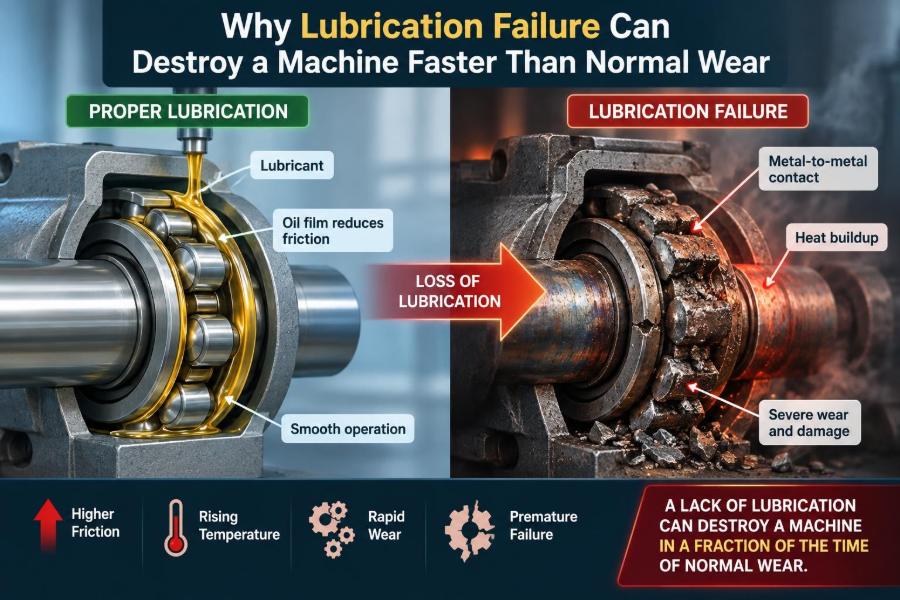
Then the temperature rises, a bearing begins to seize, metal debris enters the oil, and a repair that might have required a grease gun or oil change becomes an emergency shutdown. The machine did not simply “wear out.” Its protective lubricant film failed.
Lubrication is often treated as a routine maintenance detail, but it is one of the conditions that allows moving machine elements to survive at all. When it is wrong, absent, contaminated, or unable to reach the contact, damage can accelerate with surprising speed.
Understanding why requires more than remembering to add oil or grease. It requires seeing lubrication as a designed system involving surfaces, loads, speed, temperature, cleanliness, and maintenance decisions.
⚙️ Lubrication Is a Working Machine Component
Oil and grease are not passive fluids stored inside a machine. They form a functional layer between moving surfaces, carry heat away from loaded contacts, transport contaminants toward filters, and help protect metal from corrosion.
A lubricant must also remain stable at the machine’s operating temperature and reach the contact zone in the right amount. If it cannot perform any of these jobs, the machine may have a lubricant present but still be inadequately lubricated.
🧱 The Thin Film That Separates Metal
At a microscopic level, engineered surfaces are not perfectly smooth. They contain peaks called asperities. When two components move against each other, the lubricant film should separate most or all of these peaks.
That separation prevents direct metal-to-metal interaction. Even a very thin film can support substantial load when its viscosity, movement, and geometry create the right pressure conditions.
🔬 Three Lubrication Regimes
Tribology, the study of friction, wear, and lubrication, commonly describes three broad regimes. A machine can move between them as load, temperature, speed, or lubricant condition changes.
| Regime | Surface condition | Practical implication |
|---|---|---|
| Boundary lubrication | Asperities partly contact; chemical surface films carry much of the protection. | Common during starts, stops, and high loads. |
| Mixed lubrication | Lubricant film carries part of the load, with some asperity contact. | Wear risk rises if conditions worsen. |
| Full-film lubrication | A continuous fluid film separates the surfaces. | Usually provides the lowest wear under stable conditions. |
The goal is not always full-film lubrication everywhere. Some contacts naturally operate in boundary conditions. The key is choosing a lubricant and maintenance approach suitable for the regime the component actually experiences.
🔥 Friction Turns Failure Into Heat
When the lubricant film thins or collapses, friction rises sharply. The energy that should have moved a shaft, gear, or rolling element is converted into heat at the contact.
Heat lowers the viscosity of many lubricants, making the film thinner still. This can create a damaging feedback loop: thinner film causes more friction, more friction produces more heat, and more heat further weakens the film.
🪨 Adhesive Wear Can Escalate Quickly
Under severe metal contact, small areas of one surface can weld momentarily to another and then tear apart as motion continues. This is called adhesive wear.
The torn material roughens both surfaces. Rougher surfaces disrupt film formation and generate particles that can damage other contacts. In extreme cases, adhesive wear progresses into scuffing or seizure, where motion becomes difficult or stops entirely.
🏖️ Abrasive Particles Behave Like Grit
Dirt, metal chips, worn seal material, and other hard particles can become trapped between moving surfaces. Instead of a clean fluid film, the contact receives a circulating polishing compound.
Abrasive wear is especially harmful because it can attack several parts at once. In a hydraulic system, contaminated oil may score pump parts, valve spools, cylinder bores, and actuator seals as it travels through the circuit.
💧 Water Changes More Than Appearance
Water in oil is not merely an aesthetic problem. Free water can promote corrosion, interfere with additives, reduce film performance, and contribute to air entrainment or foaming in some systems.
In rolling-element bearings, water can damage finely finished surfaces and encourage corrosion pits. Those pits become stress concentrators, making later fatigue damage more likely even after the water source is removed.
🧪 Viscosity Must Match the Duty
Viscosity is a lubricant’s resistance to flow. It is central to film thickness: oil that is too thin for a heavily loaded bearing may not maintain separation, while oil that is too thick may circulate poorly, increase churning losses, or starve distant points during cold startup.
“Thicker is better” and “any oil is better than no oil” are both unreliable rules. The correct grade depends on component type, speed, load, temperature, clearances, and the machine manufacturer’s requirements.
🌡️ Temperature Can Defeat a Correct Oil
A lubricant selected for normal operating temperature may perform poorly outside that range. High temperature can lower viscosity, accelerate oxidation, and shorten additive life. Low temperature can make oil sluggish and grease resistant to movement.
A bearing that receives adequate oil after warming up may still experience harmful starvation during repeated cold starts. Seasonal conditions and process heat therefore belong in lubrication planning.
🧈 Grease Is Not Simply Thick Oil
Grease consists of base oil held within a thickener structure, along with additives. The thickener acts like a sponge: under working conditions, it releases oil to lubricate the contact and retains much of the material in place.
This makes grease useful for many bearings, joints, and exposed points, but it also means grease behavior depends on consistency, thickener type, temperature, speed, and mechanical working. A grease chosen only by color or convenience can be unsuitable.
🚫 Too Much Grease Can Also Cause Damage
Over-greasing is a common maintenance error. In a high-speed rolling bearing, excess grease can be churned by moving elements, producing heat and forcing grease past seals.
That heat can degrade the grease and reduce the base oil available at the contact. A grease fitting does not automatically mean “pump until grease appears everywhere”; the proper amount and relubrication interval matter.
🔄 Incompatible Greases Can Lose Structure
Different greases may use different thickener systems and base oils. Mixing them can alter consistency, oil separation behavior, or mechanical stability. The result may be soft grease that leaks away, hard grease that blocks flow, or a mixture with unpredictable performance.
Compatibility should be verified before changing products. When uncertainty remains, a controlled purge or cleaning procedure is usually safer than casually topping up with another grease.
🛢️ Oil Starvation Has Several Causes
A low reservoir level is only one cause of starvation. Blocked lines, plugged filters, failed pumps, incorrect oil level, foaming, poor splash lubrication, excessive leakage, and restricted breathers can all prevent oil from reaching a contact.
For example, a gearbox can contain the specified volume of oil while a bearing receives too little because an oil passage is blocked by sludge. Inspecting level alone cannot confirm delivery.
🫧 Foam and Entrained Air Reduce Protection
Foam is visible air bubbles at the oil surface; entrained air is air dispersed within the oil. Both can interfere with stable lubrication, reduce effective heat transfer, and make pumps deliver an inconsistent flow.
Air may enter through suction leaks, return lines that discharge improperly, low oil levels, or mechanical agitation. Resolving the cause matters more than simply adding an antifoam product.
🧯 Oxidation Creates Sludge and Varnish
Oil exposed to oxygen and elevated temperature gradually oxidizes. Oxidation products can increase viscosity, form acidic compounds, and create deposits commonly described as sludge or varnish.
These deposits may restrict small control passages, coat heat-transfer surfaces, and cause valves to stick. The damage is often indirect: degraded oil changes the operating environment until a component can no longer move or cool correctly.
🧲 Additives Protect Specific Conditions
Modern lubricants contain additives for jobs such as wear protection, oxidation resistance, corrosion inhibition, foam control, and extreme-pressure performance. An extreme-pressure additive, for instance, can form protective chemistry under severe gear contact conditions.
Additives are not universal cures. The package must suit the application, and depletion or contamination can reduce its effectiveness. Substituting a general-purpose oil for a specified product can create risks that are not obvious from viscosity alone.
⚖️ Load, Speed, and Film Thickness Interact
High load tends to squeeze the lubricant film thinner. Higher relative speed can help build a fluid film in some contacts, while very low speed makes full-film separation more difficult.
This explains why a machine may operate acceptably at steady production speed but suffer wear during slow positioning, frequent starts, or heavy transient loads. Lubrication schedules should account for the actual duty cycle, not only the nameplate rating.
🦷 Gears Need the Right Contact Protection
Gear teeth experience rolling and sliding at the same time. Their tooth flanks need a lubricant that can form a film and protect heavily loaded sliding zones, especially near gear mesh regions where conditions are severe.
Insufficient viscosity, wrong additive chemistry, contamination, or low oil level can lead to scoring, micropitting, or surface fatigue. Gear noise may be an early clue, but by the time it becomes loud, surface damage may already be established.
🌀 Bearings Fail Through More Than Wear
Rolling-element bearings are often described as low-friction parts, but their contacts are highly stressed. Inadequate lubrication can produce smearing, discoloration from heat, raceway damage, cage distress, and fatigue initiated by contaminated or corroded surfaces.
Not every bearing failure is caused by lubrication. Misalignment, improper mounting, electrical current, imbalance, and excessive load can also contribute. However, lubrication failure frequently accelerates these problems by removing the protective margin the bearing needs.
🚜 Hydraulic Systems Depend on Clean Fluid
Hydraulic fluid transmits power and lubricates pumps, motors, valves, and cylinders simultaneously. A fluid problem can therefore reduce machine motion and damage the power-generating components at the same time.
Fine clearances in servo and proportional valves are particularly sensitive to contamination. A particle too small to feel between fingers may still be large enough to interfere with a precision hydraulic passage.
📈 Early Warning Signs Are Often Measurable
Lubrication failure rarely begins with a dramatic break. Watch for changes in temperature, vibration, sound, power draw, leakage, oil appearance, grease condition, or component movement.
- A rising bearing temperature can indicate excess friction, over-greasing, excessive load, or poor lubricant condition.
- A darker oil may reflect oxidation or contamination, but color alone does not diagnose oil health.
- Unusual vibration can result from bearing damage, imbalance, looseness, or misalignment; it needs investigation rather than assumption.
Trends are generally more useful than isolated readings because machines differ in their normal operating behavior.
🔍 Oil Analysis Provides Evidence, Not a Verdict
Oil analysis can examine properties such as viscosity, contamination, water content, oxidation indicators, and wear debris. It helps maintenance teams see changes that may not yet be visible in machine operation.
Results require context. A wear-metal result may reflect a developing fault, recent repair work, sampling error, or normal break-in behavior. Consistent sampling locations, methods, and intervals make the information more reliable.
📡 Condition Monitoring Complements Lubrication Checks
Vibration analysis, ultrasound, thermography, motor current monitoring, and routine operator observations can reveal symptoms of inadequate lubrication. Each method sees a different part of the problem.
Ultrasound can be useful for detecting changes in bearing friction and guiding grease addition, while thermography can identify abnormal heating. These tools support judgment; they do not remove the need to inspect lubrication routes, seals, filters, and operating conditions.
🧰 Storage and Handling Can Ruin New Lubricant
New oil is not automatically clean enough for every machine, especially precision hydraulic or turbine systems. Open containers, dirty transfer funnels, unsealed grease guns, and poorly stored drums can introduce water and particles before lubricant enters the equipment.
Good handling includes labeled containers, clean dedicated transfer equipment, protected breathers, sealed storage, and clear separation of lubricant types. These simple controls prevent many avoidable mix-ups.
🏷️ The Right Lubricant Must Reach the Right Point
Lubrication programs fail when instructions are vague. “Grease weekly” does not identify the grease, amount, fitting location, operating state, or exceptions for unusual conditions.
Useful procedures specify the lubricant, grade, quantity, interval, method, cleanliness requirement, and inspection checks. Labels at fill points and color-coded tools can reduce human error, provided the system is maintained consistently.
🗓️ Time-Based Schedules Have Limits
Calendar intervals are practical, but machines do not all experience the same load, temperature, contamination, or runtime. A standby pump and a continuously running pump may need different lubrication attention even if they are physically identical.
Condition-based maintenance can refine intervals using operating hours, sensor trends, oil analysis, or inspection findings. It should be applied thoughtfully: a simple low-risk asset may not justify complex monitoring, while a critical machine may.
🧑🔧 Common Maintenance Shortcuts That Create Risk
Many lubrication failures begin with well-intended shortcuts. Adding grease because a bearing is noisy, using leftover oil without checking specifications, or changing oil after a fixed interval without investigating contamination can hide the real issue.
- Do not assume a noisy bearing needs more grease; damage, alignment, and load should also be considered.
- Do not mix oils based only on similar viscosity labels.
- Do not open reservoirs or remove plugs in dirty conditions unless contamination control is in place.
- Do not ignore recurring leaks; they may reduce lubricant level and admit contaminants.
🛠️ Designing Machines for Lubrication Reliability
Reliability begins in design as well as maintenance. Accessible fill points, sight glasses, sample ports, drain locations, proper seals, filtration, and clearly routed lines make correct lubrication easier and errors less likely.
Automatic lubrication systems can help where there are many points or hazardous access, but they still require verification. A blocked line or empty reservoir can leave operators with false confidence if the system is not inspected.
🧭 A Practical Response to Suspected Lubrication Failure
When abnormal heat, noise, or vibration appears, avoid treating lubricant addition as the only response. First consider whether continued operation could cause a safety risk or major damage, following site procedures and manufacturer guidance.
- Verify lubricant level, identity, and delivery path.
- Inspect for leaks, blocked lines, damaged seals, foaming, and contamination sources.
- Compare temperature, vibration, and operating conditions with prior normal trends.
- Take a representative sample when oil analysis is appropriate.
- Correct the underlying cause, then monitor the machine for evidence that conditions have stabilized.
If internal damage is suspected, a qualified maintenance professional should determine whether inspection, repair, or controlled shutdown is necessary.
🎯 The Core Principle: Preserve the Film, Preserve the Machine
Normal wear is gradual because machine surfaces are designed to operate with controlled friction and protective separation. Lubrication failure removes that separation and can create heat, roughness, contamination, and chemical degradation that reinforce one another.
The practical lesson is broader than “keep it topped up.” Use the correct lubricant, keep it clean and dry, deliver it in the correct amount, monitor changes, and investigate abnormal conditions before they become destructive.
When lubrication is treated as a precision reliability task rather than a housekeeping chore, machines have a far better chance of reaching their intended service life. A healthy lubricant film is often the small, invisible barrier standing between normal operation and rapid mechanical damage. 🔧🛢️⚙️