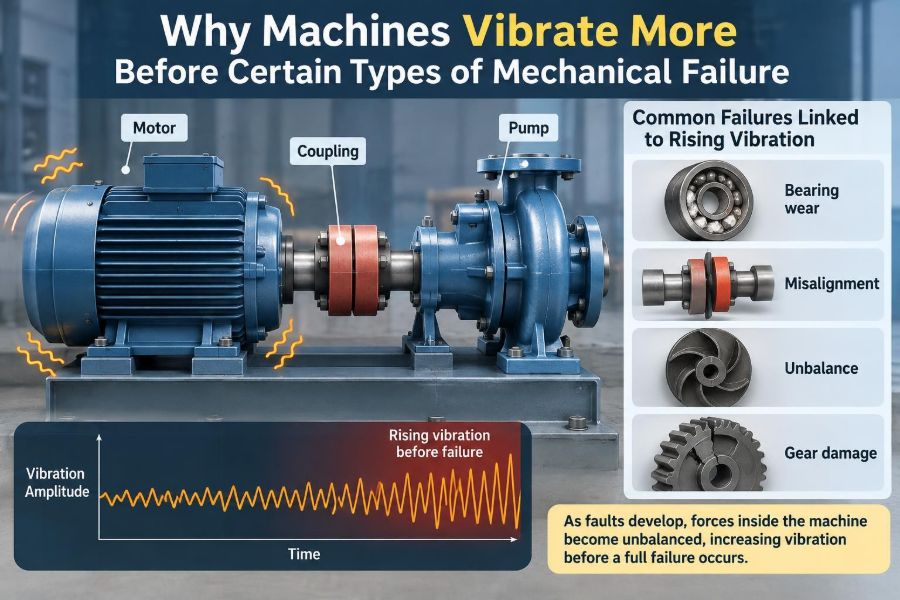

A pump that once ran with a steady hum begins to shake the pipework. A car develops a faint steering-wheel tremor at highway speed. A factory fan sounds rougher each week, even though it still delivers air.
These changes are easy to dismiss when the machine continues doing its job. Yet vibration is often one of the earliest visible or measurable signs that a rotating or reciprocating machine is losing mechanical health.
The key word is often, not always. Some failures produce little vibration, and some high vibration is harmless because it is inherent to the machine’s design or operating condition. What matters is understanding why vibration changes, where it appears, and what pattern it follows.
For students, vibration connects dynamics theory to real equipment. For working professionals, it is a practical condition-monitoring signal: a way to investigate a developing defect before it becomes unplanned downtime, damaged equipment, or a safety event.
🔊 Vibration Is Motion Around an Intended Position
Machine vibration is the repeated movement of a component around its desired position. A rotating shaft may move radially, a motor housing may oscillate, or a gearbox casing may flex very slightly as gears engage.
No real machine is perfectly motionless. Manufacturing tolerances, rotating masses, transmitted forces, and structural flexibility all create some motion. The concern begins when vibration exceeds a normal baseline, changes character, or appears at a frequency associated with a defect.
Vibration is commonly described by displacement, velocity, or acceleration. Each emphasizes a different part of the motion, but the practical question is the same: is the machine moving in a way that indicates abnormal force, looseness, or loss of stiffness?
🧭 Why Failure Changes the Vibration Signature
Most mechanical failures alter at least one of three things: the forces acting on the machine, the stiffness of its support path, or the geometry that keeps parts moving correctly.
An unbalanced rotor increases rotating force. A worn bearing introduces impacts and clearance. A crack can reduce local stiffness. Misalignment forces a coupling and bearings to accommodate motion they were not intended to carry.
These changes make vibration more noticeable because the machine is no longer simply converting power into useful motion. Some input energy is being redirected into oscillation, rubbing, impact, heat, and structural flexing.
⚡ The Basic Force Behind Rotating Unbalance
Unbalance occurs when a rotor’s mass center does not lie on its axis of rotation. As speed rises, that offset mass produces a centrifugal force that rotates with the shaft and pulls on bearings, housings, and foundations.
Even a small mass offset can matter at high speed because the force increases strongly with rotational speed. This is why a fan that seems acceptable at low speed may shake severely near its normal operating speed.
Typical causes include accumulated material on a fan blade, a missing balance weight, a bent impeller, erosion, and an uneven repair. The dominant vibration is often near once-per-revolution speed, commonly called 1× running speed.
📏 Misalignment Creates Repeating Mechanical Stress
Misalignment means connected shafts do not share the intended geometric relationship. They may be offset sideways, angled relative to one another, or both. Thermal growth, soft feet, pipe strain, and inaccurate installation can all create it.
A flexible coupling can tolerate limited misalignment, but it does not make misalignment harmless. The coupling must flex each revolution, transmitting cyclic loads into shafts, seals, bearings, and mounts.
Vibration from misalignment frequently contains running-speed components and harmonics, often with strong axial vibration near a coupling. The exact pattern varies with machine construction, coupling type, load, and sensor direction, so no single vibration peak proves misalignment by itself.
🧱 Mechanical Looseness Changes the Support Path
Looseness means a component can move more than intended. It may be a loose hold-down bolt, worn bearing fit, cracked weld, degraded grout, enlarged mounting hole, or internal clearance that has become excessive.
Unlike smooth unbalance, looseness can produce impacts. The machine may move until a clearance is taken up, strike another surface, and then reverse direction. That repeated contact creates a vibration waveform with sharp features and multiple harmonics.
Looseness can also magnify another problem. A mildly unbalanced motor on a rigid base may run acceptably, while the same motor on a loose base can excite much larger housing motion.
🪛 Bearings Often Become Noisier as Damage Develops
Rolling-element bearings support shafts through balls or rollers moving between inner and outer races. Their surfaces are carefully finished so loads are distributed across small contact zones. Lubrication separates surfaces and reduces friction.
When a race, rolling element, or cage becomes damaged, each pass over the defect can create a small impact. Early impacts may be too subtle to notice by touch, but sensitive acceleration measurements can reveal high-frequency activity.
As damage grows, the impacts become stronger and more frequent. Vibration may rise, sound rougher, and generate heat. However, a bearing can also fail through overheating, lubrication breakdown, or seizure before a simple overall vibration trend becomes dramatic.
🛢️ Lubrication Problems Affect More Than Friction
Lubricant does not merely make parts feel slippery. In bearings and gears, it helps form a film that separates surfaces, carries heat away, and protects against corrosion and wear.
Too little lubricant, the wrong viscosity, contamination, water ingress, overgreasing, or incompatible greases can disturb that film. Metal-to-metal contact and surface distress increase, often creating broadband high-frequency vibration before visible damage is obvious.
Overgreasing deserves special attention. Adding grease until it escapes does not necessarily protect a bearing. Excess grease can churn, elevate temperature, and damage seals, while also making later diagnosis more difficult.
⚙️ Gear Defects Produce Mesh-Related Vibration
Gears transfer torque through teeth that enter and leave contact repeatedly. This creates a normal gear-mesh frequency related to tooth count and shaft speed. A healthy gearbox still has mesh vibration; the useful information lies in changes to amplitude, sidebands, waveform shape, and trend.
Wear, chipped teeth, eccentric gears, backlash changes, inadequate lubrication, and misalignment can disturb the smooth transfer of load. A damaged tooth may produce a repeating impact once per revolution of that gear.
Because gearboxes contain multiple shafts and gear pairs, interpretation can become complex quickly. The measured casing response depends on sensor location, structural paths, load, and speed, not just the defect itself.
🌀 Resonance Can Turn a Small Defect Into a Large Response
Every structure has natural frequencies at which it prefers to vibrate. A tuning fork is a familiar example: a small strike produces a strong, sustained tone because the fork’s shape supports that mode of motion.
Machine frames, brackets, guards, pipes, and rotors also have natural frequencies. When a forcing frequency from rotation, gear meshing, blade passing, or reciprocating motion approaches one of them, the response can rise sharply. This is resonance.
Resonance does not create the original forcing defect, but it can make its consequences much more severe. It may also make a machine appear to have worsened suddenly when operating speed changed only slightly.
📈 Speed Changes Reveal Different Failure Behavior
A useful diagnostic clue is what happens during startup, shutdown, or variable-speed operation. Unbalance generally grows with speed, while a resonance may produce a narrow peak as the machine passes through a particular speed range.
Some defects are tied directly to shaft speed. Others are linked to load, temperature, or fluid conditions. A pump may vibrate differently at its preferred flow than when throttled far from its designed operating region.
For this reason, vibration readings should be compared at comparable operating states. A measurement from an unloaded standby machine is not automatically comparable with one taken at full process load.
🌊 Pumps Can Vibrate Because of Hydraulic Instability
Not every vibration problem begins with a broken mechanical component. Centrifugal pumps can experience hydraulic forces that fluctuate when flow is too low, too high, restricted, recirculating, or affected by air entrainment.
Cavitation is a particularly damaging example. Local pressure can fall enough for vapor bubbles to form and then collapse as pressure recovers. The collapse creates noise, vibration, and surface damage, especially near the impeller and casing passages.
A pump with hydraulic vibration may also show changing pressure, unusual sound, or unstable flow. Replacing bearings without addressing suction conditions, system resistance, or operating point may only treat the consequence.
🌬️ Fans and Compressors Have Their Own Flow Forces
Fans, blowers, and compressors interact continuously with moving gas. Dirty blades, uneven buildup, inlet distortion, blocked filters, surge, and aerodynamic stall can change the forces on rotating components.
Blade-passing frequency occurs as blades pass a fixed point or flow disturbance. In some cases, a peak at this frequency is expected; an increasing or unusually strong peak can point to airflow disruption, blade damage, clearance changes, or structural interaction.
Compressor surge is a system-level instability rather than a simple rotor defect. It can generate strong pulsation and vibration, and it should be investigated using operating data as well as mechanical measurements.
🔩 Reciprocating Machines Generate Inherent Shaking Forces
Piston compressors, engines, and pumps contain parts that repeatedly accelerate, decelerate, and reverse. Their inertia forces create vibration even when the machine is healthy, which makes baseline knowledge especially valuable.
Faults such as worn crosshead components, valve problems, rod looseness, poor balance, or foundation deterioration can alter the normal pattern. Pulsation in connected piping may also become a dominant contributor.
Diagnosis therefore needs machine-specific context. A vibration level that would be suspicious on a small electric motor may be ordinary on a reciprocating compressor, while a subtle change in the compressor’s established signature may deserve attention.
🪨 Cracks Can Reduce Stiffness Before Complete Fracture
A crack does not always announce itself with a dramatic sound. In a shaft, support, weld, or structural member, it may first reduce stiffness locally. As load changes through each rotation or operating cycle, the structure can flex differently.
This may alter vibration amplitudes, harmonics, phase, or resonant behavior. Breathing cracks, which open and close as loading changes, are especially complicated because their response can be nonlinear.
Vibration alone rarely provides enough certainty to declare a crack. Visual inspection, non-destructive testing, alignment checks, and review of operating history may be needed before making a high-consequence decision.
🔥 Rubbing Converts Motion Into Heat and Harmonics
Rubbing occurs when rotating and stationary parts contact each other where clearance should exist. Common examples include a rotor touching a seal, a fan brushing its housing, or a shaft contacting a damaged bearing surface.
Contact can generate frictional heating, a scraping sound, subharmonics, harmonics, and changing vibration as surfaces wear. Severe rubs can quickly escalate because heat causes thermal expansion, which reduces clearance further.
Rubbing is not always continuous. A shaft may contact only when load, speed, temperature, or rotor deflection reaches a particular condition. That intermittent behavior is one reason trend data matters.
🧲 Electrical Faults Can Appear as Mechanical Vibration
Motors and generators produce electromagnetic forces as they convert electrical energy into rotation. Problems such as air-gap eccentricity, loose laminations, rotor-bar defects, or supply imbalance can modulate those forces.
The casing may then vibrate at frequencies related to electrical supply and rotational effects. This does not mean every vibration at an electrical frequency is an electrical defect; mechanical resonance and sensor placement can influence the observation.
Reliable troubleshooting may require electrical tests, current analysis, temperature checks, and mechanical vibration data together. Separating electrical and mechanical causes is often a cross-disciplinary task.
📊 Overall Vibration Is a Screening Tool, Not a Diagnosis
An overall vibration value compresses a complex waveform into one number. It is useful for trending and alarm systems because a noticeable increase can indicate that the machine has changed.
But different defects can produce similar overall values. A low-frequency unbalance, high-frequency bearing impacts, and broad flow turbulence may contribute differently to the same reading.
Think of overall vibration as a general health indicator, like noticing that a vehicle sounds louder than usual. It tells you to look closer; it does not identify the worn part with certainty.
🎼 Frequency Analysis Helps Separate Likely Sources
A vibration spectrum displays signal amplitude against frequency. It can reveal whether energy is concentrated at running speed, its harmonics, gear-mesh frequencies, blade-passing frequencies, or broad frequency bands.
Frequency analysis works because machine motions are often repetitive. A shaft turning at a known speed creates repeatable events, and a defective bearing or gear can add characteristic repetition rates.
Interpretation should remain cautious. Peaks are clues, not labels. A peak may be transmitted from neighboring equipment, amplified by a support structure, or created by an interaction between several conditions.
⏱️ Time Waveforms Show Impacts and Intermittent Events
The time waveform shows vibration amplitude changing moment by moment. It is particularly useful when impacts, rubbing, looseness, or non-steady events create a shape that a spectrum alone can obscure.
For example, repeated sharp impacts may suggest a defect passing a loaded zone, while a clipped or irregular waveform may point toward contact or looseness. The actual meaning depends on timing, sensor orientation, speed, and machine design.
A good analysis often compares waveform and spectrum rather than treating either as complete evidence. One shows repetition in time; the other organizes that repetition by frequency.
📡 Envelope Analysis Can Expose Early Bearing Impacts
Early rolling-bearing defects may excite high-frequency structural resonances rather than producing a clear low-frequency fault peak. Envelope analysis, also called demodulation in many systems, extracts the repeating impact pattern from that higher-frequency response.
This can make bearing-related frequencies easier to observe when conventional spectra are crowded by running-speed and structural vibration. Proper sensor mounting and suitable measurement settings are essential.
It is powerful but not magical. Gear impacts, electrical noise, poor mounting, and nearby sources can complicate the result. Bearing diagnosis should consider lubrication condition, temperature, audible changes, and inspection opportunities.
📍 Sensor Placement Determines What You Can See
A sensor measures vibration at its mounting point, not directly at the defect. The signal travels through shafts, bearings, housings, bolts, and structures, losing or gaining energy along the way.
For rotating equipment, bearing housings are commonly useful locations because they are near force transmission paths. Measurements in horizontal, vertical, and axial directions can reveal different aspects of machine motion.
Consistent placement is vital for trending. Moving a handheld sensor from one side of a housing to another can change the reading enough to imitate a machine condition change.
🧪 Baselines Matter More Than a Single Reading
A baseline is a record of vibration when a machine is known to be operating acceptably under a defined condition. It gives later measurements context that a generic alarm threshold cannot fully provide.
Useful baseline records include speed, load, process state, temperature, recent maintenance, sensor location, measurement direction, and instrument settings. Without those details, trend comparisons can become misleading.
A gradual rise from a machine’s own stable history can be meaningful even when its absolute vibration remains modest. Conversely, a consistently higher value may be normal for a particular machine design.
📝 Trend Direction Often Matters More Than One High Value
Condition monitoring is strongest when it observes change over time. A steadily rising bearing-related indicator, repeated increase after lubrication intervals, or a new resonance peak near a common operating speed deserves investigation.
The rate of change matters as well. A slowly changing condition may allow planned repair, while a sharp shift after a process upset, impact, or maintenance task may call for faster assessment.
Trend data must still be interpreted alongside operating records. A vibration rise that coincides with higher speed or a different product flow may reflect changed excitation rather than component deterioration.
🚨 Symptoms That Deserve Prompt Attention
Some vibration changes warrant a timely review because they can indicate rapidly increasing risk, especially when several symptoms occur together.
- A sudden, sustained change from the machine’s normal signature.
- Vibration accompanied by rising bearing or casing temperature.
- New rubbing, knocking, grinding, or intermittent impact sounds.
- Visible movement of a base, guard, pipe, or anchor bolt.
- Oil leakage, debris, unusual lubricant appearance, or repeated seal failures.
- A vibration increase immediately after installation, alignment work, or process changes.
Site procedures, equipment criticality, and safety requirements should determine the response. Where rotating parts, high pressure, high temperature, or unstable equipment are involved, inspection must be performed by qualified personnel under appropriate isolation and safety controls.
🧰 Start With the Operating Condition Before Replacing Parts
A common mistake is to treat vibration as proof that a bearing, coupling, or motor must be replaced. Components do fail, but the observed vibration may originate in the process, support structure, installation, or driven equipment.
A practical first review asks: What changed? Was speed altered? Did flow, pressure, load, temperature, or product change? Was maintenance performed? Are bolts tight, guards clear, and pipes imposing load on the machine?
This sequence prevents expensive “parts swapping.” It also reduces the chance of replacing a damaged bearing while leaving the misalignment, contamination, or hydraulic condition that caused its damage unresolved.
🔧 Correct Alignment Includes Thermal and Structural Effects
Precision alignment is not simply making coupling faces look centered while equipment is cold. Machines can move as casings warm, piping expands, foundations settle, or operating loads deform supports.
Soft foot is another frequent issue: one machine foot does not sit flat on its base, so tightening bolts bends the frame. That distortion can alter alignment and create unstable vibration behavior.
Good alignment work considers coupling specifications, shaft movement, base condition, bolt torque practices, pipe strain, and expected thermal growth. The correct target may include an intentional cold offset so shafts align properly during operation.
🏗️ Foundations, Bases, and Pipework Are Part of the Machine
A machine is not isolated from its surroundings. Its foundation, skid, baseplate, grout, connected ducts, and pipework form the structural system that receives dynamic force.
A flexible or damaged support can amplify motion. Pipe strain can pull a pump casing out of alignment. A resonant guard may create a loud vibration that is more alarming than dangerous, while still masking the machine’s true condition.
Inspection should therefore include the complete force path: machine feet, fasteners, shims, baseplate, grout, structural steel, and attached services. Repairing the rotor alone may not solve a structural response problem.
🧹 Cleanliness and Balance Are Ongoing Maintenance Tasks
Balance is sometimes treated as a one-time factory property. In service, rotating assemblies change. Dust sticks to fan blades, process material coats impellers, erosion removes material, and repairs alter mass distribution.
Cleaning a fouled fan can substantially improve vibration, but it must be done safely and evenly. Removing buildup from one blade while leaving the others coated can create a different unbalance condition.
When balancing is required, the procedure should suit the rotor type and operating speed. Field balancing can be effective, but it should not be used to hide a bent shaft, loose foundation, cracked blade, or aerodynamic problem.
🧠 Avoid the “One Peak, One Fault” Diagnostic Trap
Vibration diagnosis is probabilistic. A feature can be consistent with a particular fault without being unique to it. For example, harmonics may arise from looseness, misalignment, nonlinearity, or structural effects.
Better diagnosis combines several forms of evidence: frequency content, time waveform, phase relationships, operating condition, temperature, oil analysis where appropriate, visual inspection, maintenance history, and machine geometry.
This approach is slower than naming a defect from one spectrum screenshot, but it is more defensible. The goal is not to produce the fastest label; it is to make the right maintenance decision with an appropriate level of confidence.
🛡️ Vibration Monitoring Has Limits and Needs Context
Vibration monitoring is highly useful for many rotating machines, but it cannot detect every failure mode early. Corrosion, seal degradation, electrical insulation damage, control-system faults, and certain lubrication issues may need other condition-monitoring methods.
Likewise, alarm limits should not be copied casually between unlike machines. Machine size, speed, mounting stiffness, drive arrangement, process duty, and measurement method influence what “normal” means.
A robust program treats vibration as one input in a broader reliability process. It is most valuable when measurements lead to thoughtful inspection, confirmed root causes, and feedback that improves future maintenance decisions.
✅ The Core Principle: Failure Adds Force, Clearance, or Flexibility
Machines commonly vibrate more before certain failures because the failure changes the dynamics of the system. It adds a forcing event, such as unbalance or gear impact; increases unwanted clearance, such as looseness or bearing wear; or reduces stiffness, as can occur with cracks and weakened supports.
Those changes may excite the machine at recognizable frequencies, especially if a natural frequency amplifies the response. But the measured vibration is always the combined result of the defect, operating condition, structure, sensor location, and signal-processing method.
The most useful habit is to compare a changing signature against a reliable baseline, investigate the whole machine system, and confirm the cause before choosing a repair.
Vibration is not a prediction of failure by itself; it is evidence that a machine’s forces, geometry, or support conditions may be changing—and evidence becomes valuable when it is interpreted in context. ⚙️📈🔍