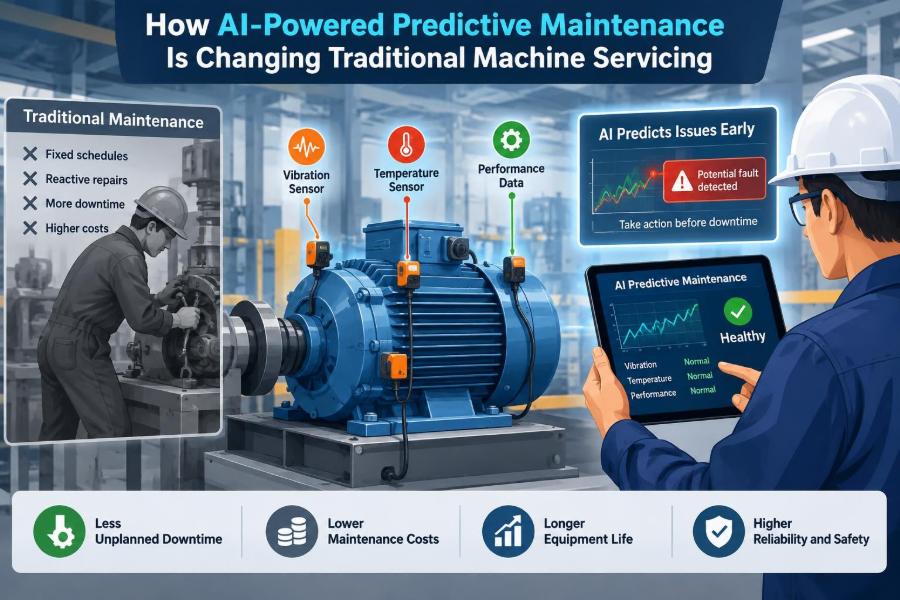

A production line is running smoothly until a conveyor drive begins to vibrate more than usual. The sound is subtle, output has not fallen, and the machine has not triggered an alarm. In a traditional maintenance routine, that drive may continue operating until the next scheduled inspection—or until it fails.
For a maintenance technician, this is a familiar tension. Stop a healthy-looking machine too often and valuable production time is lost. Wait too long, and a relatively minor bearing or alignment problem can become an emergency shutdown, damaged equipment, and a difficult repair.
AI-powered predictive maintenance aims to make that decision less dependent on calendar dates, intuition, and visible symptoms. It uses operating data to identify patterns associated with developing faults, helping teams investigate equipment when its condition calls for attention.
This does not make maintenance automatic or eliminate the need for skilled engineers. It changes the information available to them—and, when implemented carefully, changes machine servicing from a largely reactive activity into a more deliberate engineering process.
🔧 Traditional Servicing Was Built Around Time and Failure
Most industrial maintenance programs have historically relied on two basic approaches: reactive maintenance and preventive maintenance. Reactive maintenance means repairing equipment after it fails. Preventive maintenance means servicing it at planned intervals, such as every six months, every operating-hour threshold, or during an annual shutdown.
Both approaches remain useful. A noncritical, low-cost component may reasonably be run to failure, while a safety-related device may require strict time-based replacement regardless of apparent condition.
The limitation is that calendar time is only an indirect indicator of machine health. Two identical pumps can age very differently if one handles clean fluid at steady load and the other experiences cavitation, frequent starts, contaminated fluid, or poor alignment.
📉 Why Fixed Schedules Can Miss the Real Condition
A scheduled inspection can occur too early, too late, or at exactly the right moment by chance. Replacing a component that still has substantial useful life wastes labor, materials, and planned downtime. Missing a rapidly developing fault creates the opposite problem.
Equipment condition depends on many interacting factors: load, speed, temperature, lubrication quality, environment, operating cycles, installation quality, and process changes. A maintenance interval chosen for average conditions cannot fully describe all of them.
Predictive maintenance, often shortened to PdM, tries to base action on measured condition rather than time alone. The key word is “predictive,” but in practice the first value often comes from earlier detection and better prioritization—not perfect forecasts of an exact failure date.
🧠 What AI-Powered Predictive Maintenance Means
AI-powered predictive maintenance combines condition-monitoring data with algorithms that detect unusual behavior, classify known fault signatures, estimate degradation trends, or rank assets by risk. Artificial intelligence is a broad term here: it can include machine learning models, statistical anomaly detection, pattern recognition, and rules enhanced by data.
Traditional condition monitoring already uses techniques such as vibration analysis, oil analysis, infrared thermography, and ultrasound. AI does not replace these measurements. It can help process larger data streams, relate multiple signals, and highlight changes that deserve human review.
A practical system therefore has three layers: sensing the machine, interpreting its data, and deciding what action is appropriate. Failure in any one layer weakens the whole program.
📡 The Data Starts at the Machine
Machines do not announce every defect in a single, convenient signal. Maintenance systems collect evidence from sensors, control systems, inspection records, and process data. The right input depends on the asset and its likely failure modes.
- Vibration: useful for rotating equipment, gearboxes, bearings, imbalance, looseness, and misalignment.
- Temperature: can reveal friction, cooling problems, electrical resistance, or abnormal loading.
- Electrical data: motor current and power can indicate load changes, rotor issues, or mechanical resistance.
- Lubricant condition: particle counts, water contamination, viscosity, and wear debris provide clues inside enclosed machinery.
- Process variables: pressure, flow, speed, cycle time, and product quality can explain or expose machine changes.
More data is not automatically better. A reliable measurement connected to a plausible failure mechanism is more valuable than a large collection of poorly understood tags.
📳 Vibration Data Reveals Rotating-Machine Clues
Vibration monitoring is central to many predictive maintenance programs because rotating faults often create characteristic changes in frequency and amplitude. A damaged bearing, for example, may generate repeated impacts that appear at frequencies related to bearing geometry and shaft speed.
Raw vibration readings are rarely enough on their own. Analysts may examine time waveforms, overall vibration levels, frequency spectra, and envelope analysis. AI tools can assist by finding patterns across these representations, especially when machines produce data continuously.
However, the physical context still matters. A vibration increase may result from a new product recipe, a speed change, a structural resonance, or an actual defect. An algorithm can flag a deviation; engineering interpretation determines its significance.
🌡️ Temperature Is Useful but Often Ambiguous
Thermal measurements are easy to understand: an overheating bearing, electrical connection, or hydraulic component deserves attention. But temperature is influenced by ambient conditions, airflow, load, insulation, process temperature, and sensor placement.
For that reason, a meaningful model often compares temperature against operating state. A motor running hotter at the same speed and load is usually more informative than a motor that is simply hot during a hotter production day.
Thermal cameras and fixed sensors can complement each other. Cameras are excellent for periodic surveys of panels and surfaces, while fixed sensors support trend monitoring where continuous visibility is justified.
⚡ Electrical Signatures Extend Monitoring Beyond Mechanics
Motor current signature analysis uses electrical current and related signals to infer aspects of motor and driven-equipment behavior. Changes in current can reflect altered mechanical loading, supply imbalance, rotor-bar issues, or some pump and fan problems.
This approach can be attractive because current transformers may be easier to install than sensors on inaccessible rotating parts. Yet current data is not a universal diagnostic substitute. Variable-speed drives, changing process loads, and control strategies can complicate interpretation.
The strongest programs combine electrical evidence with process and mechanical data rather than treating any one measurement as a complete diagnosis.
🛢️ Oil Analysis Looks Inside Enclosed Systems
Lubricating oil carries information from within gearboxes, hydraulic systems, compressors, and engines. Laboratory analysis or online sensors can detect contamination, moisture, changes in viscosity, oxidation, and metallic wear particles.
A rising particle count may suggest wear, but it does not automatically identify which component is failing. Sampling technique, filter condition, oil type, and recent maintenance work all affect results.
AI can help trend multiple oil indicators over time, but sound lubrication practice remains essential. No algorithm can compensate for incorrect lubricant selection, contaminated storage containers, or a neglected breather.
🧩 Process Context Prevents Misleading Alerts
A pump’s vibration, power draw, and temperature may naturally vary with flow rate, fluid properties, suction conditions, and speed. If a model sees only vibration, it may treat normal operating variation as abnormal behavior.
Adding process context allows the system to compare like with like. Instead of asking whether vibration is high in general, it can ask whether vibration is unusual for this pump at this speed, flow, and operating mode.
This distinction is especially important in batch plants, flexible manufacturing cells, and equipment that runs several products. A model trained only on one normal state can generate unnecessary alarms in another.
🗂️ Good Historical Records Make Models More Credible
Maintenance records connect sensor behavior to real outcomes. Work orders, inspection notes, failure codes, replaced parts, photographs, operating hours, and root-cause findings can all help create useful training data.
Unfortunately, many records are inconsistent. “Repaired pump” does not explain whether the issue was a seal leak, bearing damage, cavitation, loose base, or electrical fault. Vague records limit the ability to train a model to recognize specific conditions.
Clear failure coding and concise technician observations improve both maintenance planning and future analytics. Data quality is not merely an IT concern; it is a maintenance discipline.
🧹 Data Cleaning Is an Engineering Task
Sensor streams often contain gaps, duplicate tags, communication dropouts, unit mismatches, and readings recorded while equipment is stopped. If these issues are ignored, a model may learn the behavior of instrumentation problems rather than the behavior of the machine.
Engineers need to define valid operating ranges, identify shutdown periods, synchronize timestamps, and confirm that tags describe the intended assets. A pressure transmitter incorrectly mapped to another pump can create convincing but useless analysis.
Data preparation may feel less exciting than AI, but it often determines whether a predictive maintenance project becomes trusted or ignored.
🔍 Anomaly Detection Finds the Unusual
Anomaly detection establishes a picture of expected behavior and flags deviations. It is particularly useful when a site has limited examples of confirmed failures, which is common because well-maintained equipment should not fail frequently.
For example, a model may learn the typical relationship between motor current, pump speed, and discharge pressure. A departure from that relationship could prompt an inspection for blockage, wear, recirculation, or instrumentation error.
An anomaly is not a diagnosis. It means “this behavior deserves explanation.” Treating every anomaly as a failure prediction is one of the fastest ways to lose confidence in a system.
🏷️ Fault Classification Requires Reliable Labels
Fault classification attempts to identify a condition such as imbalance, misalignment, bearing damage, gear wear, or lubrication contamination. These models are valuable when labeled examples are sufficiently accurate and representative.
The challenge is that real industrial faults can overlap. Misalignment can accelerate bearing wear, looseness can distort vibration signatures, and a process upset can resemble a mechanical problem. Models must be tested against realistic operating conditions, not only neat training examples.
Classification should support, not override, inspection. A technician may confirm the diagnosis with alignment checks, lubricant examination, visual inspection, or more detailed vibration analysis.
⏳ Remaining Useful Life Is a Careful Estimate
Some systems estimate remaining useful life (RUL): the time or usage expected before a component reaches an unacceptable condition. This can help coordinate spares, labor, and planned outages.
RUL is inherently uncertain. Degradation rates can change after a load increase, a lubrication correction, a contamination event, or a change in operating duty. A forecast should therefore be presented as a range or decision aid, not as a precise promise.
For many plants, a simpler question is more actionable: can this asset safely and reliably run until the next planned shutdown? That decision still requires knowledge of consequence, redundancy, and available repair options.
🧭 From Alert to Maintenance Decision
An alert has value only when it leads to a clear workflow. Someone must review it, verify the equipment state, assess severity, and decide whether to inspect, monitor more closely, plan work, or intervene immediately.
A useful escalation path often includes:
- Validate that the signal and sensor are functioning correctly.
- Check operating context and compare with other relevant measurements.
- Perform targeted field inspection or diagnostic testing.
- Evaluate consequence, redundancy, safety, and production risk.
- Create a scoped work order with the required parts and skills.
- Record what was found so the system can improve.
Without this bridge between analytics and the maintenance management system, alerts become another dashboard rather than a service improvement.
🛠️ Predictive Maintenance Changes Work Planning
Traditional servicing often creates a large amount of routine work at fixed intervals. Predictive insights can help teams focus effort where condition evidence indicates a developing issue, while leaving healthy assets in service when appropriate.
This can improve job preparation. If a gearbox shows a worsening vibration pattern, planners may arrange a compatible replacement, lifting equipment, permits, lubricant, and skilled labor before the work window begins.
Planned corrective work is usually less disruptive than emergency work because the team has time to isolate hazards, confirm the scope, and avoid rushed decisions.
🏭 A Pump Example Shows the Difference
Consider a hypothetical process pump monitored for vibration, motor current, suction pressure, discharge pressure, and bearing temperature. A model detects rising vibration only during a certain flow range, alongside unstable suction conditions.
Rather than immediately replacing the bearing, the maintenance and process teams investigate. They find that a partially obstructed suction strainer and changed operating conditions are contributing to cavitation-like behavior. Correcting the process issue may prevent further mechanical damage.
This example illustrates a crucial point: predictive maintenance is not just about predicting component failure. It can expose the operating conditions that create failure.
🧱 Asset Criticality Determines Where to Start
Not every machine deserves continuous sensing or advanced analytics. A sensible program begins with assets where unexpected failure has meaningful safety, environmental, quality, production, repair-cost, or customer consequences.
Criticality also considers redundancy. A duty/standby pump may tolerate a different monitoring strategy from a single compressor with no backup. The best candidate is not always the most expensive machine; it is often the one where earlier knowledge changes the decision.
Starting with a small, high-value asset group makes it easier to validate the workflow before scaling across an entire facility.
📊 Comparing Maintenance Approaches
| Approach | Trigger for work | Best fit | Main limitation |
|---|---|---|---|
| Reactive | Failure or obvious malfunction | Low-consequence, inexpensive assets | Unplanned downtime and possible collateral damage |
| Preventive | Calendar time, cycles, or operating hours | Known wear items and compliance-driven tasks | May replace healthy parts or miss variable degradation |
| Condition-based | Measured condition crosses a defined criterion | Assets with observable degradation | Requires suitable measurements and interpretation |
| AI-assisted predictive | Pattern, trend, anomaly, or risk estimate | Complex data and variable operating conditions | Depends heavily on data, workflow, and validation |
These approaches are not mutually exclusive. Effective reliability programs deliberately use a mix based on failure mode and consequence.
✅ The Benefits Depend on Better Decisions
The main benefit of AI-assisted maintenance is not that software “knows” a machine better than everyone else. It is that the system can continuously organize signals, identify changes, and bring relevant evidence to the people responsible for decisions.
When the program works well, teams can reduce avoidable emergency work, schedule interventions more thoughtfully, make better use of shutdown windows, and protect components from secondary damage. It may also improve communication between operations, maintenance, reliability, and engineering.
Benefits vary widely by asset type, plant maturity, sensor quality, and response discipline. They should be assessed against real operational outcomes rather than the number of alerts produced.
🚨 False Alarms Can Create Their Own Failure Mode
Too many low-value alerts lead to alarm fatigue. People begin to dismiss notifications, including the rare warning that truly matters. A model with impressive technical sensitivity can still fail operationally if it overwhelms the team.
Alert thresholds should reflect consequence and actionability. A minor deviation on a redundant asset might create a weekly review item, while a rapidly changing condition on critical equipment may warrant immediate escalation.
Every closed alert is an opportunity to improve the system. Was it a sensor issue, normal operating variation, a genuine early warning, or an incomplete diagnosis? Feedback should refine both the model and the workflow.
🧪 Validation Must Happen in Real Operating Conditions
A model should be tested against independent data and reviewed during normal operations before it is trusted for consequential decisions. Performance can shift when equipment is rebuilt, sensors are replaced, controls are modified, or production changes.
Validation also needs a practical question: did the alert provide enough lead time for useful action? Detecting a failure seconds before a shutdown may be technically accurate but operationally inadequate.
Engineers should document assumptions, known blind spots, and conditions under which the model should not be used. This is especially important where maintenance decisions affect safety barriers or regulated equipment.
🔐 Connectivity Introduces Cybersecurity Responsibilities
Predictive maintenance often connects sensors, gateways, historians, cloud platforms, and maintenance software. Each connection can expand the digital attack surface if it is not designed and managed carefully.
Industrial systems need appropriate network segmentation, access control, software update practices, asset inventories, and vendor-management procedures. Cybersecurity responsibilities should be addressed before large-scale connectivity is installed, not after an incident.
Availability matters as much as confidentiality. A maintenance platform should not create a pathway that disrupts machine control or compromises safe operation.
👷 Human Expertise Remains Central
A seasoned technician can recognize a changing sound, smell overheated insulation, notice a loose foundation bolt, or question a sensor reading that does not fit the machine’s history. These observations are difficult to capture fully in data.
AI can make that expertise more scalable by directing attention to the right equipment and preserving patterns across many assets. But the strongest results come when technicians participate in model review and diagnosis, rather than receiving unexplained instructions from a remote system.
Explainable outputs matter. A useful alert should show the affected asset, time trend, operating context, contributing signals, confidence or uncertainty where available, and the recommended next check.
🎓 Maintenance Roles Are Evolving, Not Disappearing
As monitoring becomes more capable, maintenance work increasingly includes data interpretation, sensor verification, reliability analysis, and cross-functional problem solving. Core mechanical skills remain necessary because the equipment is still physical and failure mechanisms are still physical.
Teams benefit from training that covers both domains: vibration fundamentals, lubrication, alignment, instrumentation basics, data quality, and the limitations of predictive models. Operations personnel also need to understand why stable operating practices improve diagnostic accuracy.
The goal is not to turn every mechanic into a data scientist. It is to ensure that people using the system can recognize when its output is useful, incomplete, or wrong.
🧰 Integration With CMMS Makes Insights Executable
A computerized maintenance management system (CMMS) stores asset records, work orders, labor history, parts information, and maintenance plans. Connecting predictive insights to the CMMS helps convert condition evidence into accountable work.
Integration should be selective. Automatically creating a work order for every anomaly can flood planners with noise. A better design may route alerts through a reliability review, then generate work only when the condition and response are understood.
Once work is completed, technician findings should return to the analytics process. This closed loop is how a program becomes progressively more useful instead of remaining a one-way alert system.
📦 Spare Parts Strategy Becomes More Informed
Condition visibility can improve spare-parts planning by providing earlier notice that a repair may be needed. That can reduce the temptation to hold excessive inventory solely because failures are unpredictable.
Yet predictive signals do not remove supply-chain uncertainty. Long-lead components, repairable spares, and safety-critical items may still require strategic stocking. A forecast is not a substitute for a resilience plan.
Maintenance, procurement, and stores teams should agree on how alerts influence reservations, purchasing, and rebuild decisions. Otherwise, an early warning may still end in a long wait for a part.
🧾 Common Implementation Mistakes
Many disappointing projects fail for practical reasons rather than algorithmic ones. Avoiding a few recurring mistakes improves the odds of useful adoption.
- Installing sensors before identifying the asset’s credible failure modes.
- Using poor maintenance records as if they were reliable fault labels.
- Measuring model success by dashboard activity instead of maintenance outcomes.
- Ignoring changing operating states, shutdowns, and process context.
- Failing to assign ownership for alert review and response.
- Assuming a vendor model transfers unchanged to every machine and plant.
- Allowing alerts to bypass safety procedures, technical review, or work planning.
The remedy is usually disciplined engineering: define the problem, verify the data, test the workflow, and learn from each confirmed result.
🚀 A Practical Path to Adoption
Begin with a limited use case where a developing condition can be measured and where earlier action would genuinely improve the outcome. Define the failure modes, decision owner, response time, and evidence needed before selecting technology.
Next, establish a baseline of normal operation and verify sensor installation, data transmission, and asset naming. Run the system alongside existing practices long enough to evaluate alert quality without creating unsafe reliance on an unproven output.
Scale only after the team can explain how alerts are reviewed, how work is initiated, how findings are recorded, and how results are measured. A modest program with trusted decisions is more valuable than a facility-wide system nobody uses.
📏 Measuring Value Without Chasing a Single Metric
Useful measures might include the proportion of alerts that led to verified findings, the lead time available before intervention, emergency-work trends, repeat failures, schedule compliance, and the quality of maintenance feedback. No single measure tells the whole story.
It is also worth tracking negative outcomes. Did monitoring prompt unnecessary work? Did technicians lose time investigating sensor faults? Did an alert arrive too late to change the maintenance decision?
Balanced measurement encourages honest improvement. The purpose is not to prove that AI is always right; it is to determine whether the maintenance system is making better decisions overall.
🔮 Where the Technology Is Heading
Predictive maintenance systems are increasingly combining data from multiple sources, including control systems, portable diagnostic tools, inspection images, maintenance records, and digital models of assets. Better integration may make it easier to see relationships between process conditions and equipment health.
Edge computing—processing data near the machine—can support faster analysis or reduce the need to transmit every raw signal. Digital twins, which are data-informed representations of physical assets or processes, may support scenario analysis when their assumptions are well understood.
These developments will not remove the fundamentals: a credible failure mechanism, trustworthy measurements, and a response process that respects safety and uncertainty.
🧠 The Core Principle: Better Evidence, Better Maintenance
AI-powered predictive maintenance is changing traditional machine servicing because it shifts attention from “when was this last serviced?” toward “what is this machine telling us now?” That is a meaningful change, but it is not a license to abandon preventive tasks or professional judgment.
The most effective programs combine condition monitoring, process knowledge, clear maintenance records, robust planning, and skilled human review. They use AI to narrow uncertainty, not to pretend uncertainty has disappeared.
For students, the lesson is that modern maintenance sits at the intersection of mechanics, instrumentation, data, and operations. For working professionals, the opportunity is to turn machine data into earlier, safer, and more practical decisions.
Predictive maintenance succeeds when technology helps people act on credible evidence before a manageable defect becomes an unplanned failure. 🏭🔧📈